Car wash
Compressor for car washes
Air compressor for car washes: rollover gantries, jet wash bays, blow guns and tyre inflators. E series piston or S 55 and S 75 screw. 2-year warranty.
At a car wash, water and chemicals do the visible work, but compressed air runs much of the machinery behind it. On a rollover gantry it drives the cylinders that press and lift the brushes, switches the pneumatic valves and often powers the dosing pumps and the foam generator. On self-service jet wash bays it opens and closes the programme valves and feeds the foam brush or foam lance. At the vacuum stations, the blow gun and the tyre inflator run off the same network. When the compressor stops, the whole site stops with it.
How much air does a car wash need?
Work it out station by station. The figures below are indicative only: the gantry or bay manufacturer's manual gives the exact flow and pressure for its equipment.
- Rollover gantry: around 200 to 300 l/min during a wash cycle (cylinders, valves, foam).
- Jet wash bay: around 30 to 60 l/min per bay for valves and foam.
- Blow gun: about 150 l/min, tyre inflator: about 100 l/min, according to our configurator. Both are used in short bursts, so count them at 50%: the air receiver absorbs the peaks.
Then add a margin of at least 25% for seal wear, the small leaks that are unavoidable in a wet environment, and a future bay.
Example of a typical wash centre: 1 gantry, 4 jet wash bays and 2 vacuum stations with blow gun and inflator.
- Gantry: 250 l/min
- Bays: 4 × 50 = 200 l/min
- Stations: 2 × (150 + 100) × 50% = 250 l/min
- Total: 700 l/min, or about 875 l/min with the 25% margin.
If your gantry manual gives the air demand in another unit, our flow and pressure converter converts l/min to m³/min.
Which compressor for a car wash?
Small site: 2 bays and one vacuum station
With a demand of around 300 l/min including margin, the E 75 piston compressor 7.5 kW is enough: 0.9 m³/min, 180 L receiver, 8 or 12.5 bar. A piston compressor suits intermittent use, which is what a small site with bays that rarely run at the same time looks like. It is also simple to maintain.
A gantry and a few bays: the S 55
Once a gantry runs cycle after cycle all day, demand becomes continuous. The S 55 screw compressor 5.5 kW delivers 0.6 m³/min at 8 bar, or 600 l/min. That is the right size for 1 gantry and 2 bays. It runs at variable speed, matching output to what the site uses, and restarts by itself as soon as pressure drops below the set point. Its noise level of 65 to 68 ± 2 dB(A) helps when the site has neighbours.
Full wash centre: the S 75
For the example above (875 l/min), the S 75 screw compressor 7.5 kW delivers 1.1 m³/min at 8 bar. It is supplied without receiver or dryer: pair it with a receiver sized using our air receiver size calculator and with a dryer. Several gantries or a tunnel wash need more: the S 110 or a project quoted to your needs.
What air quality does a car wash need?
- Water comes first. Every compressor produces condensate. At a car wash, it sticks pneumatic valves, washes the grease out of cylinders and, in winter, can freeze in lines that run outdoors or under the gantry. An air dryer after the receiver is essential. A refrigerated dryer is fine if the whole network stays in a heated room; if some lines are exposed to frost, a desiccant dryer reaches a much lower dew point. Our article which air dryer to choose compares the two.
- Oil. Our compressors are oil-lubricated. For the blow gun used on paintwork and glass, add fine filters, including a coalescing filter that captures oil aerosols.
- Air class. Our technicians help you define the right air class under ISO 8573-1, explained in our compressed air quality guide.
Installation and maintenance
- The room. Install the compressor in a closed plant room, frost-free, ventilated and protected from water spray and chemical fumes. Our article on compressor room installation sets out the basics.
- Draining. Car washes often run unattended, so an automatic condensate drain avoids missed drains. Condensate contains oil: route it through an oil/water separator before discharge, in line with local regulations. Our article on water in compressed air covers every drain point.
- Servicing. On the S 55 and S 75, the first service is at 500 hours, then every 1,500 hours, with a reminder on the controller. Our service kits bundle the filters and wear parts for each model. On a piston compressor, the usual rule of thumb is an oil change about every 500 hours and at least once a year. Our technicians and partner dealers can also take care of maintenance and inspections.
AIRSTAHL compressors carry a 2-year warranty, with spare parts available for 15 years.
To size your site, use the configurator or the air receiver size calculator, then send us your list of gantries and bays in a quote request.
Frequently asked questions — Car wash
Which compressor for a car wash?
For a small site with 2 bays, the E 75 piston compressor (0.9 m³/min, 180 L receiver) is enough. Once a gantry runs all day, move to a screw compressor: the S 55 (600 l/min at 8 bar) for one gantry and 2 bays, the S 75 (1.1 m³/min at 8 bar) for a full wash centre with several bays and vacuum stations.
How much air does a rollover car wash gantry use?
As an indication, around 200 to 300 l/min during a wash cycle, for the brush cylinders, valves and foam. The exact figure is in the gantry manufacturer's manual. Add the bays, the vacuum stations and a margin of at least 25% to size the compressor.
Does a car wash need an air dryer?
Yes. Condensate sticks pneumatic valves, wears cylinders and can freeze in the lines in winter. A refrigerated dryer is fine if the whole network is in a heated room. If some lines are exposed to frost, a desiccant dryer, which reaches a much lower dew point, is the better choice.
Where should a car wash compressor be installed?
In a closed, ventilated, frost-free plant room, protected from water spray and wash chemical fumes. Fit an automatic condensate drain, because car washes often run unattended. Condensate contains oil and must go through an oil/water separator before discharge.
Piston or screw compressor for a car wash?
A piston compressor suits intermittent use, such as a small site whose bays rarely run at the same time. A gantry running cycle after cycle creates continuous demand, which is what a screw compressor such as the S 55 or S 75 is built for. It is also quieter, at 65 to 68 ± 2 dB(A).
How much air does a car wash with 4 jet wash bays and no gantry need?
As a guide, 4 jet wash bays use around 300 l/min including margin, and about 450 l/min with a vacuum point fitted with a blow gun and a tyre inflator. A compressor of 0.6 to 0.9 m³/min covers this. If a rollover gantry is added to the bays, aim for 1.1 m³/min instead. The step-by-step calculation is in our article on car wash air consumption.
How can I tell if my car wash air network is leaking?
Run the shutdown test at the end of the day: stop the gantry and the bays, keep the network pressurised and let the compressor build up pressure and stop. If it restarts while nothing is using air, air is escaping somewhere. The longer it runs compared with the time it stays off, the bigger the leaks. In a car wash, vibrating fittings, lance hoses and solenoid valves can lose more air than a whole bay uses.
Where should the dryer go when some car wash pipes run through cold areas?
A refrigerated dryer belongs in a ventilated, frost-free room: placed outdoors, it freezes itself. For pipes exposed to frost, a desiccant dryer, whose dew point goes well below zero, is what protects the network. Also fit an automatic drain on the air receiver and on every low point: a receiver full of water sends liquid water back into the dryer.
The recommended models
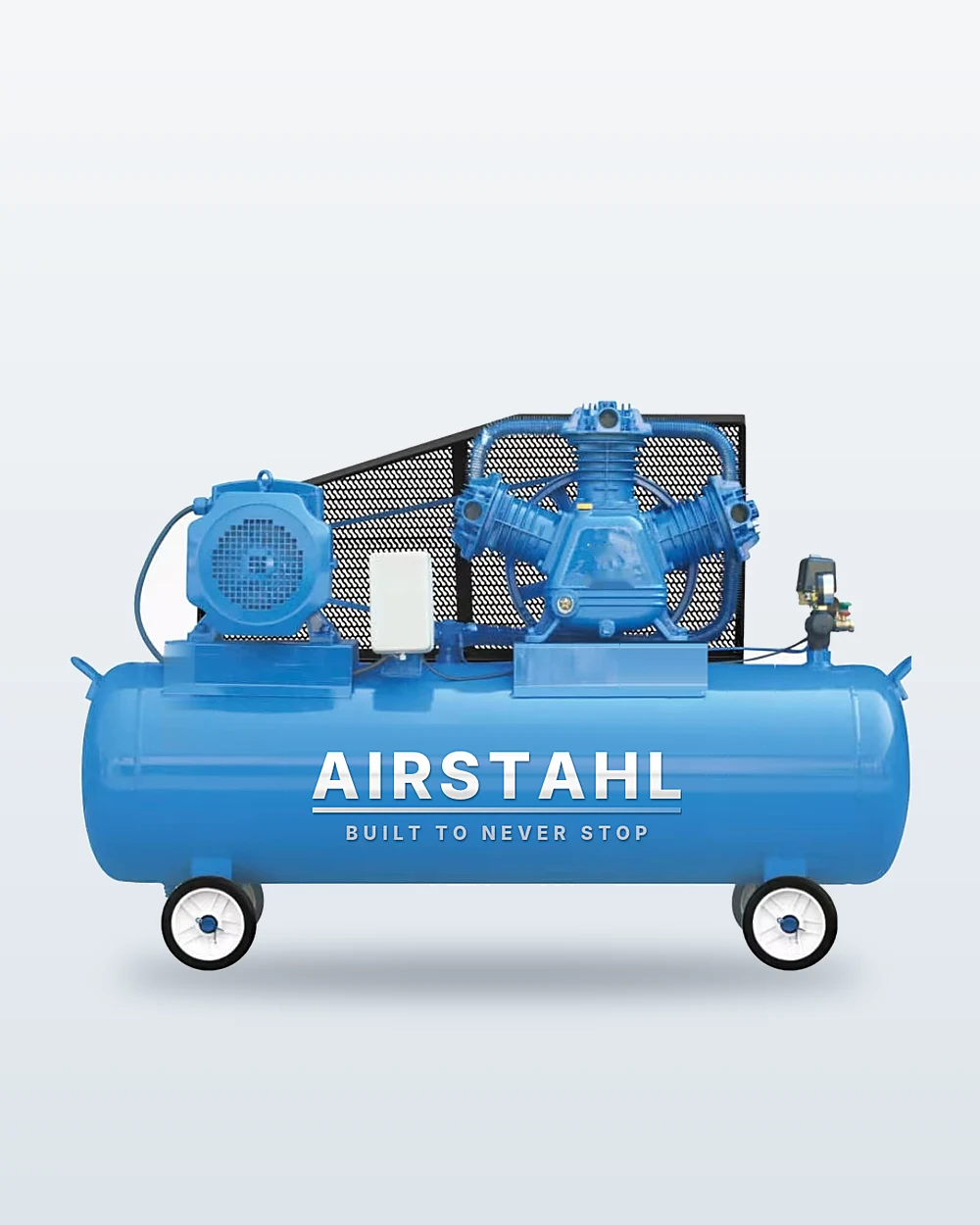 7.5kW
E 75Piston compressor 7.5 kW
More power for the garage's air tools.
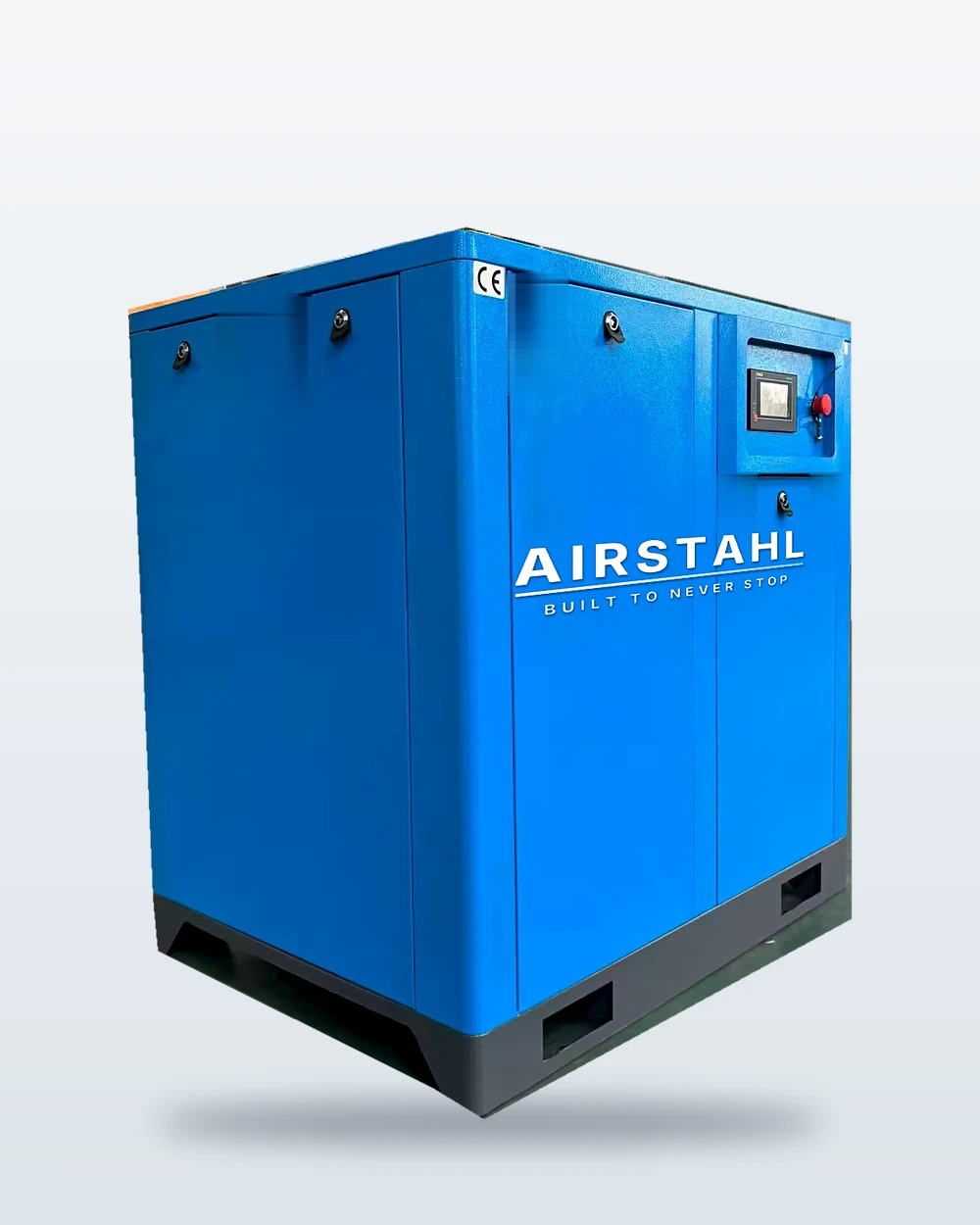 5.5kW
S 55Screw compressor 5.5 kW
The entry-level screw compressor for workshops that run all day long.
7.5kW
S 75Screw compressor 7.5 kW
The power to supply several workstations at the same time, without losing pace.
Other trades
A project, a question?
We answer quickly and quotes are free. Tell us what you run on air and we'll point you to the right model.