Timber framing and timber construction
Compressor for timber framing
Air compressor for timber framing: framing nailers in series, staplers, blow guns, prefab workshop and site. E 75 piston, S 55 screw, M 75 mobile compressor.
In timber framing and timber frame construction, compressed air is first of all about nailing. Strip and coil framing nailers for studs, plates and trusses, staplers for breather membranes and vapour barriers, sheathing nailers for OSB and racking boards: on a panel prefabrication table, several carpenters fire hundreds of nails an hour. Add the blow gun to clean tables and freshly cut timber, and sometimes pneumatic screwdrivers or drills. Unlike a joinery workshop, where air also feeds finishing spray guns, here everything comes down to flow in series production and keeping up with the site.
How much air do framing nailers need?
Our configurator uses, as an indication, about 80 l/min per nailer or stapler in normal use, at around 6 bar, and about 150 l/min for a blow gun. A framing nailer driven at a high firing rate uses more: check the tool's data sheet, which gives the air used per shot and the working pressure.
The calculation is simple:
- Count the tools working at the same time, not the ones hanging on the wall.
- Add up their consumption. Tools used in short bursts, such as the blow gun, count at 50%: the air receiver absorbs the peaks.
- Add a margin of at least 25% for long hoses, tool wear and a future station.
Example of a timber frame prefabrication workshop: 5 nailing and stapling stations on two tables, plus a blow gun.
- Nailers and staplers: 5 × 80 = 400 l/min
- Blow gun: 150 × 50% = 75 l/min
- Total: 475 l/min, or about 595 l/min with the 25% margin.
Which compressor for timber framing?
A carpenter who nails from time to time: the E 75
For one or two nailers and a blow gun, used at the pace of installation, the E 75 piston compressor 7.5 kW is the simplest answer: 0.9 m³/min, 180 L receiver on wheels, 8 or 12.5 bar. A piston compressor is built for intermittent use and needs rest periods between cycles.
Cutting and prefabrication workshop: the S 55
Once the nailing tables run all day, demand becomes continuous. The S 55 screw compressor 5.5 kW delivers 0.6 m³/min at 8 bar, or 600 l/min: it covers the workshop in the example above. It runs at variable speed and adjusts its output to the number of carpenters nailing. It is supplied without receiver or dryer; pair it with a receiver sized using our air receiver size calculator. If the workshop grows, the S 75 delivers 1.1 m³/min at 8 bar.
Erection on site: the M 75
On site, you need a compressor that moves. The M 75 mobile screw compressor 7.5 kW is mounted on a 180 L receiver and wheels: 1.0 m³/min at 10 bar, with no fixed installation. The 10 bar leave headroom for the pressure drop in long hoses running up to the deck or the roof. It is electric: plan for a 380 V three-phase supply on the site distribution board. For a one-off job, compressor rental is another option.
What air quality for timber framing?
- Water. Framing workshops are often barely heated sheds. Condensate rusts nailers, washes out their lubrication and can freeze in hoses in winter. Drain the receiver every day and fit an air dryer: refrigerated if the network stays in a heated area, desiccant if lines are exposed to frost. Our article which air dryer to choose explains the choice.
- Tool lubrication. Many nailers need a few drops of pneumatic tool oil. Follow the manual: a lubricator at the station, or oil added by hand each day.
- Oil and particles. Our compressors are oil-lubricated. For nailing, a particle filter at the start of the network is usually enough. To go further, our fine filters and our ISO 8573-1 guide help you define the air class with our technicians.
Installation and maintenance
- Sawdust. The compressor draws in the surrounding air. Keep it away from cutting machines and saws, or install it in a separate, ventilated room. Check the intake filter often: in a timber workshop it is the first part to clog.
- The network. On a prefabrication table, provide a drop with a quick coupling at each station rather than one long hose. Our guide on connecting a compressor to the air network sets out the rules.
- Draining. An automatic condensate drain means no one forgets the receiver on Friday evening.
- Servicing. On the S 55 and M 75, the first service is at 500 hours, then every 1,500 hours, with a reminder on the controller. Our service kits bundle the filters and wear parts for each model. On the E 75, the usual rule of thumb is an oil change about every 500 hours and at least once a year, as explained in our piston compressor maintenance schedule.
AIRSTAHL compressors carry a 2-year warranty, with spare parts available for 15 years.
To size your workshop or site, use the configurator or the air receiver size calculator, then send us your list of tools in a quote request.
Frequently asked questions — Timber framing and timber construction
Which compressor for a framing nailer?
For one or two nailers used at the pace of installation, the E 75 piston compressor (0.9 m³/min, 180 L receiver on wheels) is enough. For a prefabrication workshop where several stations nail all day, choose a screw compressor such as the S 55 (600 l/min at 8 bar). On site, the mobile M 75 (1.0 m³/min at 10 bar) moves with the crew.
How much air does a framing nailer use?
Our configurator uses, as an indication, about 80 l/min per nailer in normal use at around 6 bar. At a high firing rate, a framing nailer uses more: the tool's data sheet gives its air use per shot. Add up the tools used at the same time and allow at least 25% margin.
Which compressor should I take to a timber frame site?
The M 75 is an electric screw compressor mounted on a 180 L receiver and wheels, with no fixed installation. Its 10 bar leave headroom for long hoses up to the roof. It needs a 380 V three-phase supply on the site board; for short jobs, rental is also an option.
How do I keep water out of nailers in winter?
Drain the receiver every day, or fit an automatic condensate drain, and add an air dryer. A refrigerated dryer is fine if the network stays in a heated area; if lines are exposed to frost, a desiccant dryer is the better choice. Keep the compressor itself frost-free too.
What is the difference between a compressor for timber framing and one for joinery?
In joinery, air also feeds finishing spray guns, which need dry, finely filtered air. In timber framing, what matters is flow for several nailers in series, coping with a barely heated shed and being able to go to site. Hence a piston for occasional use, a screw for the workshop and a mobile unit for erection.
Which compressor for a prefabrication workshop with 6 to 8 nailing stations?
For two tables and 6 to 8 stations, aim for about 1.1 m³/min: the S 75 standalone screw compressor, or the K 75 4-in-1, which includes the air receiver, dryer and filtration. Beyond that, or if a nailing bridge is added, move up to the S 110 (1.7 m³/min at 8 bar). A table with 3 or 4 stations can manage with the S 55. See our article on the compressor for timber frame wall prefabrication.
Why do the nailers lose power when several carpenters nail at the same time?
Most often, it is the hose. Three nailers connected with tees at the end of one long hose make the pressure drop just when everyone fires, and the nails no longer go fully in. Run one hose per carpenter from a manifold placed near the compressor, or a fixed network with drop points, and fit a regulator at each station so that every tool gets its own working pressure.
Can a framing compressor be plugged into a 230 V socket?
Not ours: the E 75, S 55 and M 75 run on 380 V three-phase. From around 4 kW, professional compressors are almost always three-phase, because a single-phase motor of that size draws a very high current at start-up. On site, plan a three-phase socket on the distribution board, with no coiled extension lead or multi-socket adapter.
The recommended models
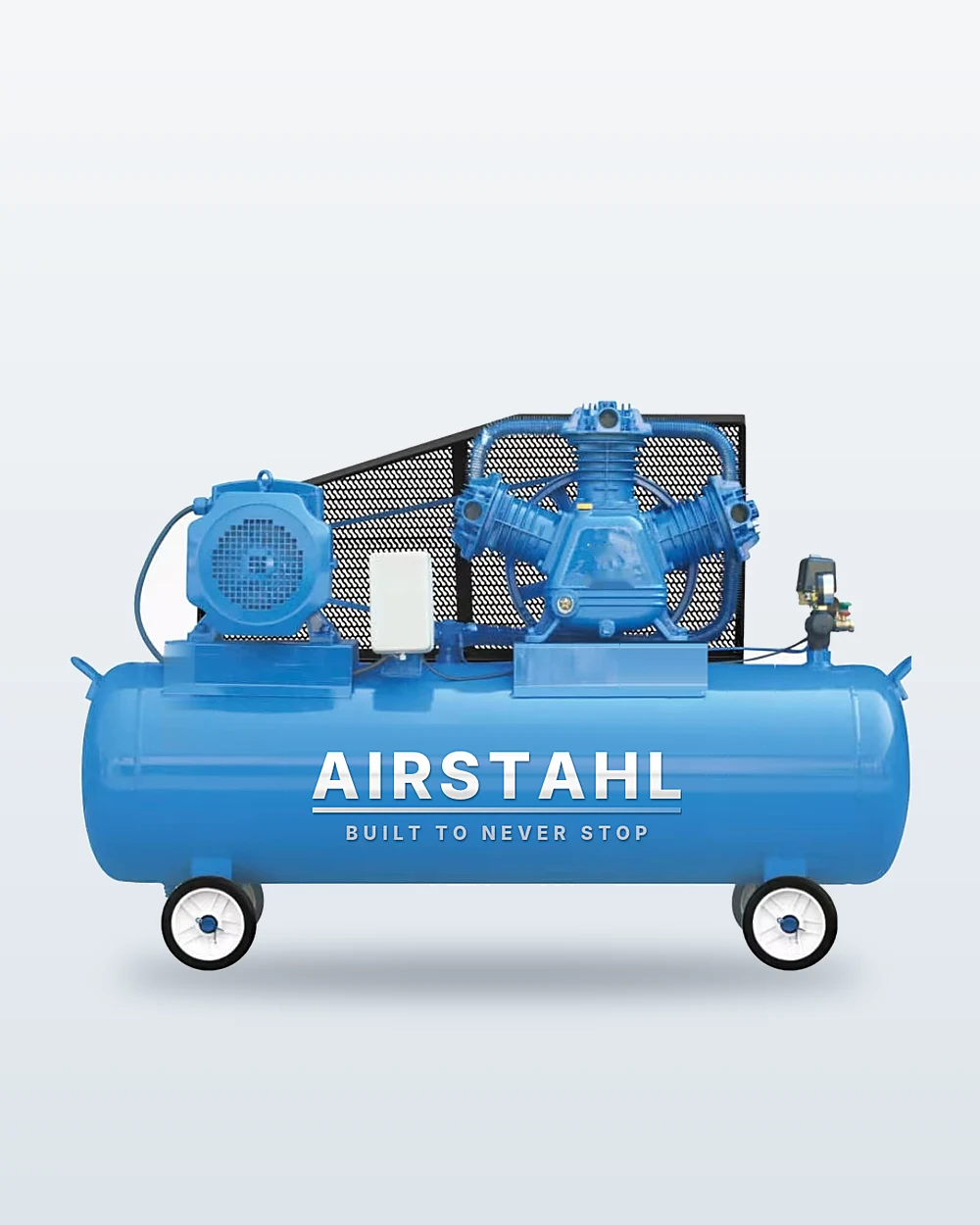 7.5kW
E 75Piston compressor 7.5 kW
More power for the garage's air tools.
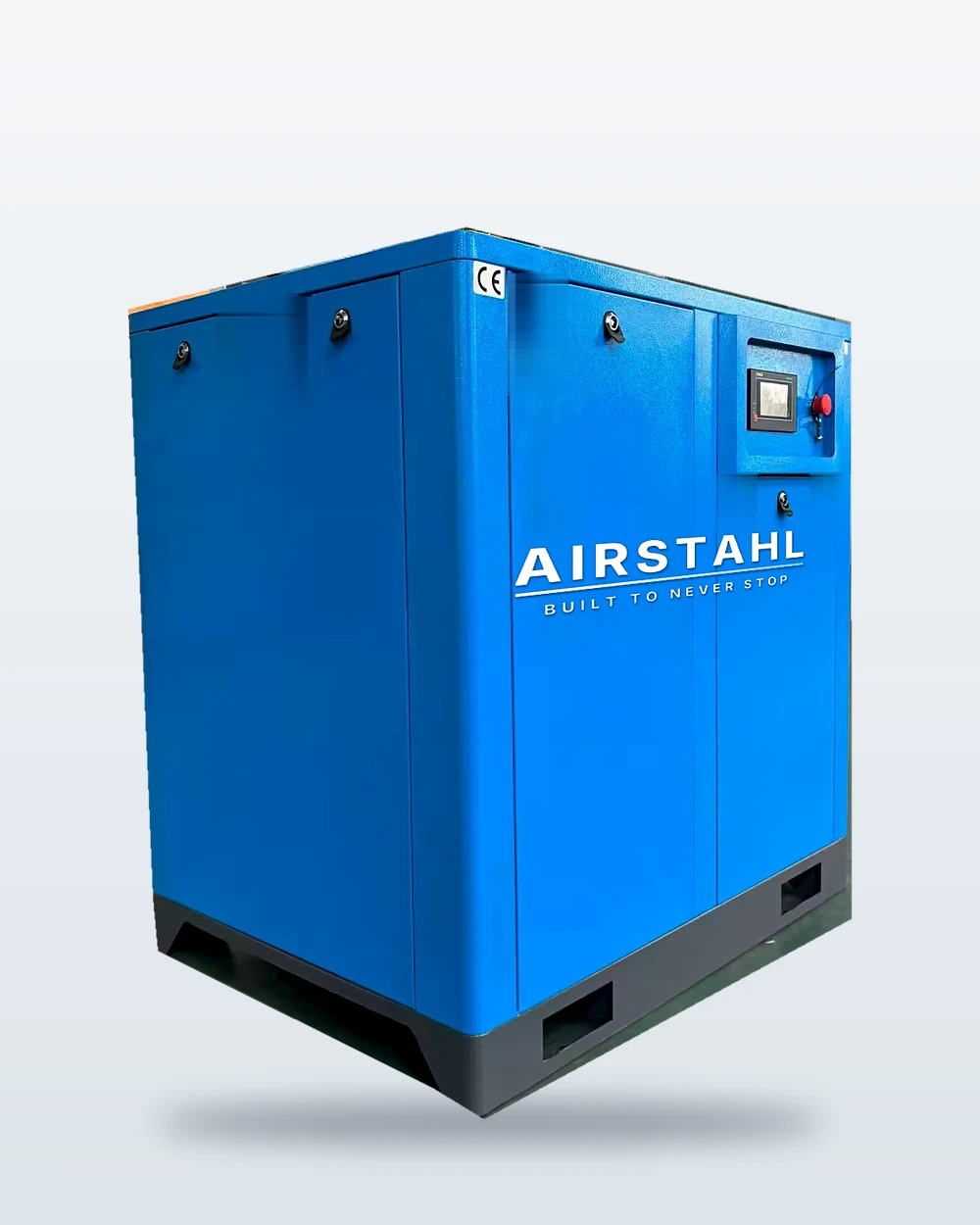 5.5kW
S 55Screw compressor 5.5 kW
The entry-level screw compressor for workshops that run all day long.
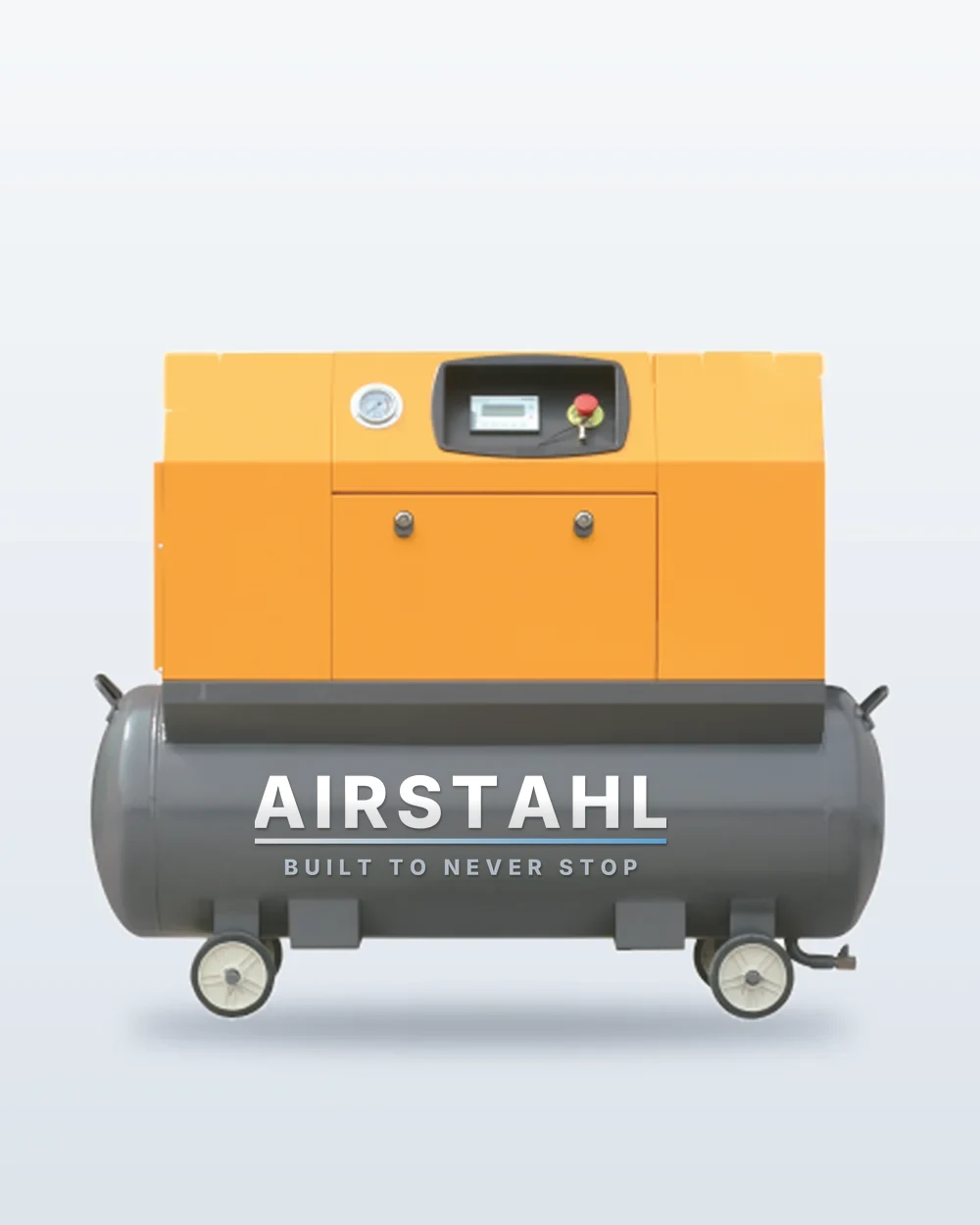 7.5kW
M 75Mobile screw compressor 7.5 kW
A plug-and-play screw compressor on a tank and wheels, easy to move from one workstation to another.
Other trades
A project, a question?
We answer quickly and quotes are free. Tell us what you run on air and we'll point you to the right model.