Consumables and equipment
Air dryers
Refrigerated dryers matched to each compressor size, and desiccant dryers for very dry air.
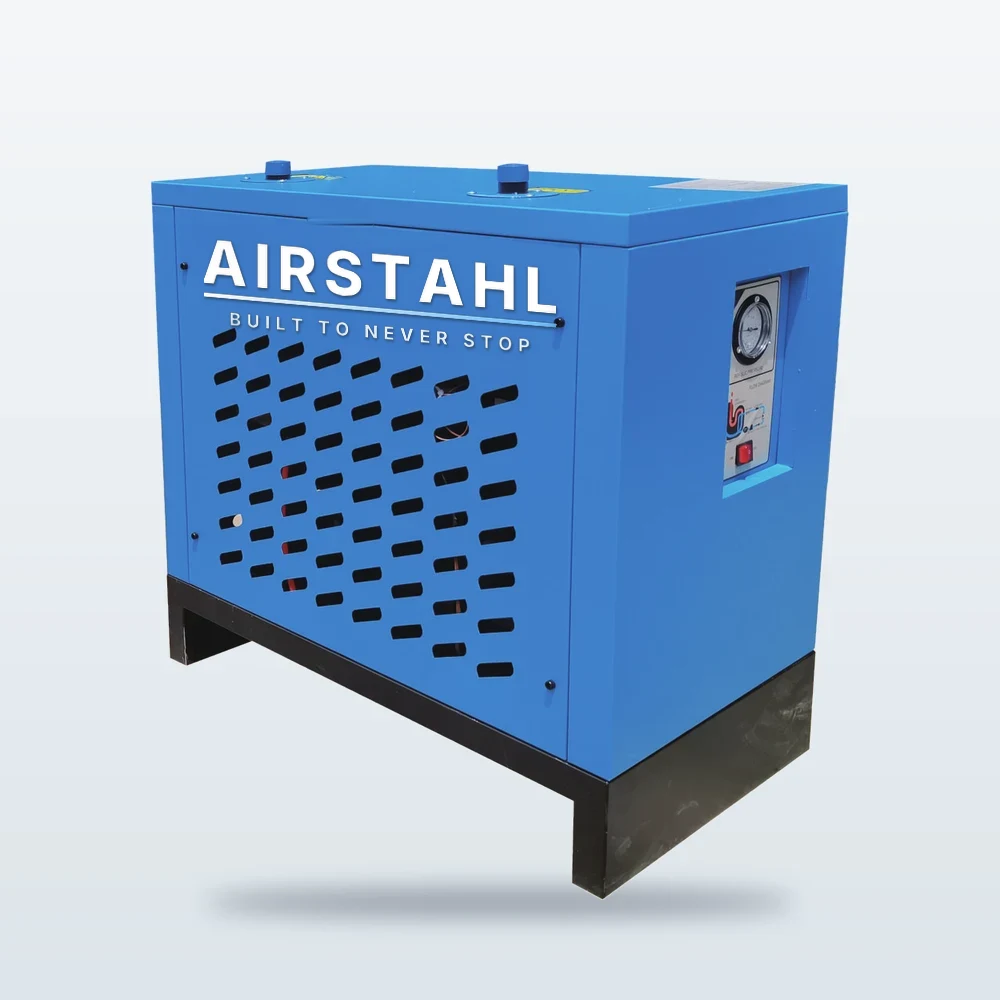
Refrigerated dryer for 5.5 and 7.5 kW compressors
Refrigerated dryer for 11 kW compressor
Refrigerated dryer for 15 kW compressor
Refrigerated dryer for 22 kW compressor

Desiccant dryer
Why dry compressed air?
The air drawn in contains water vapour. When it is compressed and then cooled, this water condenses in the receiver, the hoses and the tools. The result: rust in the network, air tools that wear faster, and defects in paints and varnishes. The dryer removes this moisture before it reaches the workstations.
Refrigerated or desiccant?
- Refrigerated dryer: it cools the air to condense the water, then drains it away. It suits the vast majority of heated workshops: garages, body shops, joinery shops, production.
- Desiccant dryer: the air passes through a desiccant that captures the moisture. It reaches a much lower dew point, for networks exposed to frost or processes that require very dry air.
Where to install it?
The standard order is compressor, receiver, dryer, filters, then network. The dryer must have an air flow at least equal to that of the compressor. Our refrigerated dryers are offered by screw compressor power, to keep sizing simple. The 4-in-1 compressor already includes a dryer.
Frequently asked questions — Air dryers
Refrigerated or desiccant air dryer: which should I choose?
A refrigerated dryer cools the air to condense the water out: its dew point, a few degrees above zero, is enough for the vast majority of heated workshops (garages, body shops, joinery shops). A desiccant dryer passes the air through a drying agent and reaches well below zero: it is the right choice for networks exposed to frost or processes that need very dry air. It is, however, more expensive, and its regeneration uses part of the compressed air or energy.
How do I size a compressed air dryer?
The dryer's rated flow must be at least equal to the compressor's air flow. That rating is given for reference conditions: a high inlet temperature, a hot room or a different working pressure change its real capacity, and dryer manufacturers provide correction factors to account for this. In a hot room, size up; we size the dryer on quotation according to your compressor and your use.
Should the dryer go before or after the air receiver?
After the receiver: the air has already cooled there and part of the water has been drained, which takes load off the dryer. The usual order is compressor, receiver, dryer, filters, then the workshop network. The screw compressor 7.5 kW 4-in-1 already combines a 420 L receiver, a refrigerated dryer and filtration: it connects straight to the network.
Why is there water in my compressed air?
The air drawn in by the compressor always contains water vapour: compression concentrates it and, as it cools in the receiver and pipework, it condenses. Draining the receiver and low points removes liquid water, but not the remaining vapour: only a dryer removes it. If water still comes through with a dryer fitted, check its automatic condensate drain, its sizing and the ventilation of the room.
How do you maintain a refrigerated air dryer?
Maintenance is straightforward: regularly check that the automatic condensate drain is clearing the water, replace the pre-filter element as recommended and keep the condenser clean. Ventilate the room, as the dryer gives off heat and loses efficiency in a hot space. Follow-up of your installation can be arranged from the site's Maintenance and inspections page.
Do I need filters with an air dryer?
Yes: the dryer removes moisture, the filters capture particles and oil, and the two work together. A pre-filter fitted before the dryer protects it, and downstream filters refine air quality to suit your use, for example spray painting. The screw compressor 7.5 kW 4-in-1 already includes a refrigerated dryer and filtration.
Need a part?
Give us the model and serial number, and we will confirm the correct part number.