Car detailing and valeting
Compressor for car detailing and valeting
Air compressor for car detailing and valeting: tornado-type cleaning gun, drying, air polishers. Flow worked out, dry filtered air that won't mark interiors.
For a detailing studio with one or two people, a compressor that delivers around 600 to 900 l/min at 8 bar is enough: the S 55 screw compressor (600 l/min) or the E 75 piston compressor (900 l/min, 180 L air receiver). As soon as two air cleaning guns (tornado type) and an air polisher run together, move up to the K 75, a 4-in-1 screw compressor delivering 1.1 m³/min (about 39 CFM) with a built-in dryer and filtration. In every case, the air must reach the gun dry and filtered, or it will mark the seats and the headlining.
In detailing and valeting, compressed air is a finishing tool. The tornado-type cleaning gun lifts dust out of air vents, seat rails and stitching by spinning a cleaning solution in a vortex. The blow gun dries door seals, mirrors, badges and wheels after the wash. Depending on how the unit is equipped, the air also drives air polishers, a venturi vacuum, a spray-extraction machine for upholstery and the tyre inflator. One drop of water on a light-coloured headlining and the job has to be done again: air quality matters as much as flow.
How much air do the tools in a detailing studio use?
The figures below are indicative only. The exact consumption of each tool is in its manual, often in l/min or in CFM; our flow and pressure converter does the conversion.
| Tool | Indicative consumption | How it is used |
|---|---|---|
| Air cleaning gun (tornado type) | around 300 to 450 l/min at 6 bar | in long bursts while the interior is cleaned |
| Wide-nozzle drying blow gun | around 250 to 400 l/min | at the end of the wash, several minutes per car |
| Standard blow gun | about 150 l/min | in short bursts |
| Air polisher | about 400 l/min | continuously while polishing |
| Venturi vacuum | often several hundred l/min | continuously while it is vacuuming |
| Tyre inflator | about 100 l/min | a few seconds per wheel |
The tornado-type gun is the tool that sizes most studios. It uses a lot of air for a hand tool, and it blows for a long time. The full calculation for this tool is in our article which compressor for a tornado cleaning gun.
How do you work out the air flow for a detailing studio?
Our configurator uses a simple method that you can repeat by hand:
- List the tools and their consumption.
- Count continuous tools at 100% (polisher, venturi vacuum) and intermittent tools at 50%, because the air receiver absorbs the peaks.
- Keep only the tools used at the same time: as many tools as there are people working.
- Add a 25% safety margin (leaks, worn couplings, pressure drop in the hoses), then 20% for expansion (one more bay, a new tool).
Example of a two-person studio equipped with two tornado-type guns, an air polisher, a drying blow gun and a tyre inflator. One person polishes while the other cleans an interior.
- Polisher, continuous tool: 400 l/min
- Tornado-type gun, used in bursts and counted at 50%: 350 × 0.5 = 175 l/min
- Simultaneous need: 400 + 175 = 575 l/min
- With the 25% safety margin: 575 × 1.25 = 719 l/min
- With 20% for expansion: 719 × 1.2 = 863 l/min, rounded up to 870 l/min
This need is above the 600 l/min of the S 55 and fits within the 1,100 l/min of the K 75. If the studio has no air polisher and works mainly with the tornado gun, the need drops back to 500 to 600 l/min and an S 55 or an E 75 is enough. For a studio with two or three bays, our article how many l/min for a detailing studio goes through several set-ups.
Which compressor should you choose for a detailing studio?
One person, regular use: the E 75 piston compressor
The E 75, a 7.5 kW piston compressor, delivers 0.9 m³/min at 8 bar (or 12.5 bar) with a 180 L air receiver. It suits a detailer working alone, with breaks between cars. It is louder than a screw compressor, so it is best installed in a separate room. The E series is available on quotation. The differences between the two technologies are explained in piston or screw compressor.
One or two people, all day long: the S 55 screw compressor
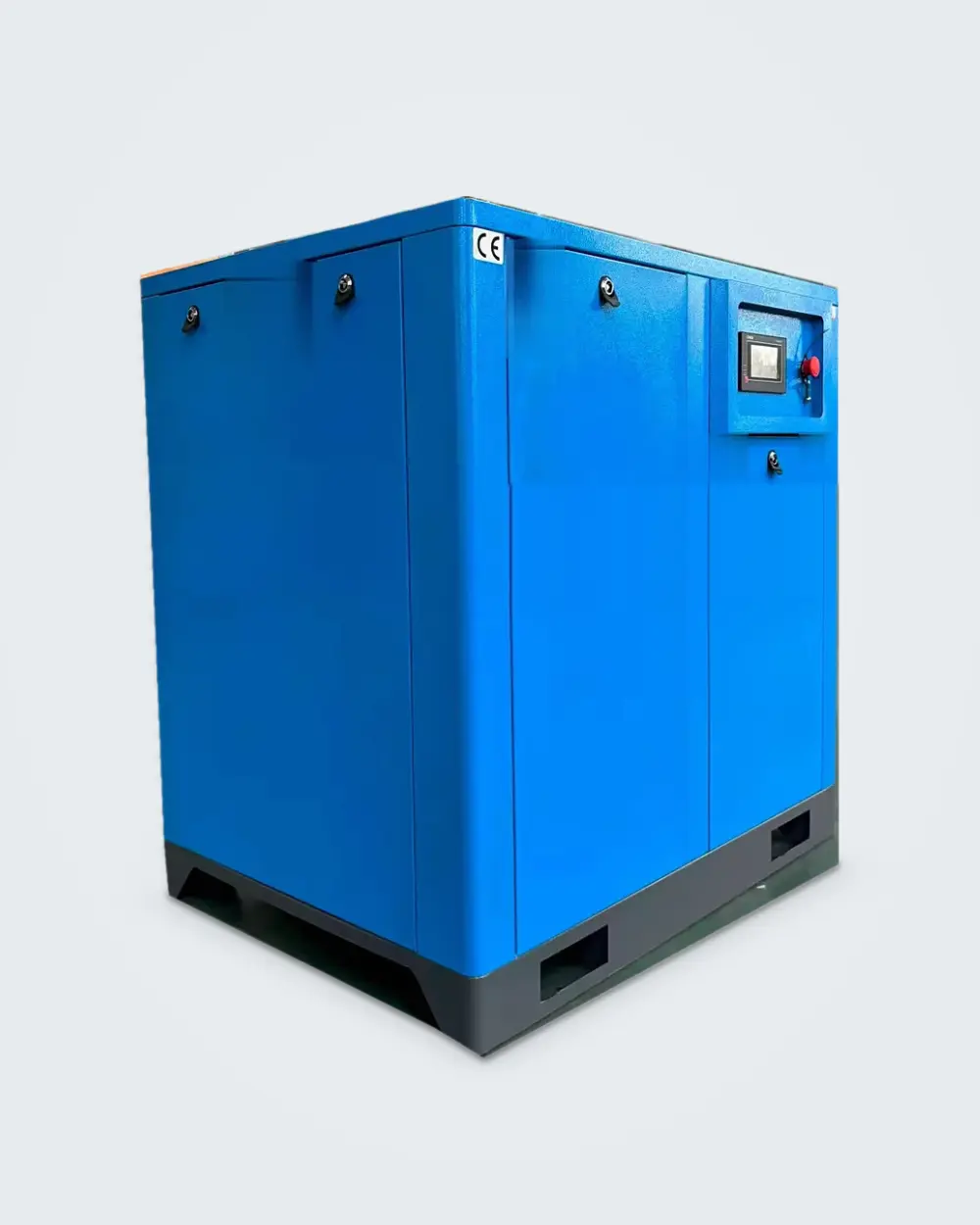
The S 55, a 5.5 kW screw compressor, delivers 0.6 m³/min at 8 bar and runs continuously without overheating. It is a variable-speed machine: it slows down when the tornado gun stops and speeds up when it starts again, instead of switching between load and idle. At 65 to 68 dB(A), it stays discreet. It is supplied on its own and is paired with an air receiver, a dryer and filters.
Several bays: the K 75 4-in-1
The K 75 combines, on a single frame, a 7.5 kW screw compressor, a 420 L air receiver, a refrigerated dryer and the filtration. It delivers 1.1 m³/min at 8 bar, which covers two to three bays with tornado guns and a polisher. The built-in dryer settles the water question from day one. For three bays that all work continuously, or a unit that also does paintwork or alloy wheel refurbishment, the K 110 goes up to 1.7 m³/min.
Why must the air be dry and filtered for detailing?
When it leaves the compression element, the air is hot and loaded with water vapour. As it cools in the air receiver and the pipes, that water condenses. Our compressors are lubricated: a small amount of oil is carried along with the air and has to be held back by the filtration. Without treatment, the tornado gun sprays droplets of water and a fine oil mist onto the upholstery. The result: tide marks on the seats, stains on the headlining, a greasy film on the glass.
The treatment chain to plan for:
- A refrigerated dryer at the compressor outlet, which brings the pressure dew point down to around +3 °C (built into the K 75).
- An automatic drain on the air receiver and at the low points, to remove the condensate.
- Fine filters at the point of use, as close as possible to the hose reels: a particulate filter, a coalescing filter that captures oil aerosols, and an activated carbon filter for vapours and odours.
The air quality class to aim for under ISO 8573-1 is set with our technicians; our air quality guide explains how to read it. The subject is covered in detail in our article dry, filtered air so you don't mark the interior.
What pressure should you set for the tornado gun and the polisher?
Cleaning guns and polishers generally work at around 6 to 6.3 bar at the tool inlet. Set the compressor to 8 bar to cover the losses through the dryer, filters and hoses, and fit a regulator with a pressure gauge at the bay. Going higher increases leaks without cleaning any better. A tornado gun that sprays the cleaner as a jet rather than a mist is often short of pressure: check the hoses and the quick couplings.
Mobile valeting or fixed studio: what can the compressor do?
Our compressors are stationary machines powered from a 380 V three-phase supply. They equip the studio, not the van: a mobile detailing vehicle uses a dedicated on-board compressor, which we do not offer. The M series, on wheels, is still electric on 380 V: it suits an extended job on a site with the right supply, such as a vehicle fleet depot, not a round of private customers. The full comparison is in mobile valeting or fixed studio.
Should you dry the car with compressed air?
Compressed air is very good at drying the places where water hides: door seals, mirrors, grille, wheel nuts, badges. On large panels, a microfibre drying towel or an electric turbine blower does better. The consumption per vehicle is worked out in our article on drying a car with compressed air after washing. If you also run wash bays or a gantry, see our page compressor for car washes.
Installation and maintenance
- The room. A detailing studio is damp and full of product vapours: install the compressor in a separate room that is dry and ventilated. See our article on the compressor room.
- The network. One hose reel per bay and hoses of a good bore limit the losses. See a garage air network with hose reels.
- Maintenance. On our screw compressors, the first service is at 500 hours, then every 1,500 hours, with service kits available online. Replace the fine filter elements when their manufacturer says so: a saturated filter no longer protects anything. The compressors come with a 2-year warranty and spare parts remain available for 15 years.
To size your installation, enter your tools in the configurator and choose the detailing activity, or send us the list of your bays with a quote request.
Typical tools in this trade
| Tool | Consumption | Typical number |
|---|---|---|
| Tornado-type cleaning gun | ≈ 350 l/min | 2 |
| Polisher / rotary sander | ≈ 400 l/min | 1 |
| Drying blow gun (wide nozzle) | ≈ 300 l/min | 1 |
| Tyre inflator (cars) | ≈ 100 l/min | 1 |
Indicative average consumption. The configurator calculates your exact demand.
AIRSTAHL Lab
Recommended air quality
Painting and finishing — Dry, filtered air for paint and clearcoat spray guns.
Calculate my demand for this tradeFrequently asked questions — Car detailing and valeting
Which compressor do you need for a car detailing studio?
For one or two people, a compressor delivering around 600 to 900 l/min at 8 bar is enough: the S 55 screw compressor (600 l/min) or the E 75 piston compressor (900 l/min, 180 L air receiver). With two air cleaning guns (tornado type) and an air polisher, move up to the K 75, a 4-in-1 delivering 1.1 m³/min with a built-in dryer and filtration.
How much air does a tornado-type air cleaning gun use?
As a guide, around 300 to 450 l/min at 6 bar, depending on the nozzle and the model; the exact figure is in the gun's manual. Because it blows for a long time on an interior, count it in full: 350 × 1.25 × 1.2 = 525 l/min with the safety and expansion margins. See which compressor for a tornado cleaning gun.
Why does my tornado-type gun leave tide marks on the seats?
Most often, the air contains condensed water or oil aerosols that the gun sprays onto the fabric. You need a refrigerated dryer at the compressor outlet, an automatic drain and fine filters at the bay, with a coalescing filter and activated carbon. Too much cleaning product, or a gun that is short of air flow, can also soak the fabric.
Does the air from your compressors contain oil?
Our screw compressors are lubricated: an air/oil separator holds back most of the oil, and the filtration at the outlet captures the aerosols carried along with the air. For air blown onto the seats and the headlining, add fine filters and an activated carbon filter at the point of use. The air quality class under ISO 8573-1 is set with our technicians.
What pressure should you set for car detailing?
Tornado-type cleaning guns and air polishers generally work at around 6 to 6.3 bar at the tool inlet. Set the compressor to 8 bar to cover the losses through the dryer, filters and hoses, and fit a regulator with a pressure gauge at the bay. A higher pressure increases leaks without cleaning any better.
Can your compressor be fitted in a mobile valeting van?
No. Our compressors are stationary machines powered from a 380 V three-phase supply. The M series, on wheels, is still electric on 380 V and weighs around 240 kg for the M 75: it suits a job on a site with the right supply, not a van. For a mobile detailer, our compressors equip the fixed base. See mobile valeting or fixed studio.
How much air does it take to dry a car after washing?
A drying blow gun uses around 250 to 400 l/min, and drying the seals, mirrors, grille and wheels takes around 3 to 8 minutes. At 300 l/min for 6 minutes, that makes about 1,800 litres of free air per vehicle. Dry the large panels with a microfibre towel and keep the air for the nooks and crannies: see drying a car with compressed air.
Piston or screw compressor for car detailing?
The E 75 piston compressor suits a detailer working alone in sessions with breaks. As soon as the tornado-type gun or the polisher runs for much of the day, a screw compressor is the better fit: the S and K series are designed for continuous running and their variable speed follows demand. They are serviced at 500 hours, then every 1,500 hours, with a 2-year warranty.
The recommended models
 7.5kW
E 75Piston compressor 7.5 kW
More power for the garage's air tools.
 5.5kW
S 55Screw compressor 5.5 kW
The entry-level screw compressor for workshops that run all day long.
 7.5kW
K 75Screw compressor 7.5 kW 4-in-1
Compressor, 420 L air receiver, refrigerated dryer and filtration combined on a single frame.
11kW
K 110Screw compressor 11 kW 4-in-1
Compressor, air receiver, refrigerated dryer and filtration combined on a single frame, at 11 kW.
Other trades
A project, a question?
We answer quickly and quotes are free. Tell us what you run on air and we'll point you to the right model.