Bakery and patisserie
Air compressor for bakeries, patisseries and viennoiserie
Bakery air compressor for dough dividers, moulders, egg wash, release agent, cream injectors and airbrush. Flow worked out, dry filtered air, K series.
A craft bakery with a patisserie section usually needs between 300 and 600 l/min of compressed air, margins included. A 7.5 kW 4-in-1 screw compressor such as the K 75, which delivers 1.1 m³/min (about 39 CFM) at 8 bar with a built-in dryer and filtration, covers that with capacity to spare. A viennoiserie unit or a central production kitchen supplying several shops moves up to the K 110 or the K 150. The calculation is done machine by machine, from the manufacturers' manuals.
In the bakehouse and the pastry kitchen, compressed air drives the cylinders on dough dividers and divider-rounders, on moulders and on the cutting stations of automatic sheeters. It pushes cream through injectors and depositors, sprays egg wash and release agent, feeds the pastry chef's airbrush and closes bags on the bagging machine or the bag clipper. For a complete production line, from the flour silo to depanning, see our article on the compressor for an industrial bakery.
How much air does a bakery and patisserie need?
Every manufacturer gives the machine's air consumption in its manual, in l/min or in litres per cycle, along with its working pressure. Add up the machines that run at the same time, count the tools used in short bursts at half their consumption, then add the two margins used by our configurator: 25% for safety and 20% for a future machine.
Example of a bakery with a bakehouse and a small pastry kitchen (typical values, for guidance only, to be replaced with the figures in your manuals):
| Station | Consumption | Counted |
|---|---|---|
| Pneumatically operated divider-rounder | 60 l/min | 60 l/min |
| Egg wash or release agent sprayer | 80 l/min | 80 l/min |
| Cream injector or depositor | 50 l/min | 50 l/min |
| Decorating airbrush | 20 l/min | 20 l/min |
| Bagging machine or bag clipper | 60 l/min | 60 l/min |
| Blow gun for flour-free cleaning, in bursts | 150 l/min | 75 l/min |
| Total | 345 l/min |
The calculation step by step:
- Machines running at the same time: 345 l/min.
- Safety margin of 25%: 345 × 1.25 = 431 l/min.
- Expansion margin of 20%: 431 × 1.2 = about 518 l/min, at 8 bar.
The K 75 delivers 1,100 l/min at 8 bar. It covers this demand and easily absorbs a new depositor or a second moulder. Our air receiver size tool checks that the receiver can keep up with the peaks of your machines.
Which compressor for a bakery or a patisserie?
The choice depends on flow, air quality and noise. The K series puts the variable speed screw compressor, the air receiver, the refrigerated dryer and the filtration on a single frame. The air comes out already dry and filtered, which simplifies the filtration stage you add for food contact.
| Business | Demand with margins | Recommended model |
|---|---|---|
| Craft bakery and patisserie | up to 1,100 l/min | K 75, 4-in-1 7.5 kW, 420 L receiver, 66 ± 2 dB(A) |
| Small bakery that already has a dryer and receiver | up to 600 l/min | S 55, standalone screw 5.5 kW, 0.6 m³/min at 8 bar |
| Central production kitchen, viennoiserie, several shops | up to 1,700 l/min | K 110, 4-in-1 11 kW, 1.7 m³/min at 8 bar |
| Semi-industrial unit with sheeting and bagging line | up to 2,200 l/min | K 150, 4-in-1 15 kW, 2.2 m³/min at 8 bar |
A bakery starts work at night and stops and starts all day. A variable speed compressor slows down when moulding stops instead of running idle. At 65 to 68 dB(A) for the S 55 and 66 ± 2 dB(A) for the K 75, these compressors remain acceptable in a back room below flats, provided you follow the rules in our article on compressor noise and neighbours.
For the detailed choice in a high-street shop, read which compressor for a craft bakery. For a pastry unit, see the compressor for a pastry kitchen.
What air quality for dough, egg wash and release agent?
Our compressors are oil-lubricated. The air leaving the screw element contains water, particles and traces of oil, and the dryer and filtration of the K series remove most of them. What you add depends on what the air touches:
- Machine cylinders and controls (divider, moulder, sheeter, bagging machine): the air does not touch the product, and K series air is suitable as it is.
- Egg wash or release agent spraying, airbrush: the air carries the sprayed product onto the dough or the tin. Fit fine filters, including an activated carbon stage, as close to the spray gun as possible.
- Cream injectors and depositors, blowing out moulds or trays: depending on the machine, the air may touch the filling or the surface that receives it. The point-of-use filtration is defined with the machine manufacturer.
The class to reach under ISO 8573-1 is set station by station, with our technicians, your HACCP plan and, where relevant, your customers' specifications. Our article compressed air in contact with dough, which filtration explains the method, and the ISO 8573-1 air quality guide shows how to read the classes. For egg wash and release agent, see egg wash and release agent spraying.
Can you blow flour away with a blow gun?
No. Never blow flour off mixers, tables or machines with a blow gun. Flour suspended in the air forms a cloud of combustible dust, the same family of risk as in a grain silo. Blowing also spreads it across the whole bakehouse, onto finished products and into the machine motors. Clean flour up with a vacuum and a brush, and keep the blow gun for parts with no flour dust on them, outside production.
Areas where flour can form a cloud, around a silo or a sifter for example, fall under a risk assessment carried out by your safety manager, sometimes under the ATEX regulations. The compressor itself always stays outside these zones. Our article on ATEX zones in silos sets out the principle.
Where should the compressor go in a bakery?
- Away from the flour. A compressor draws in several hundred litres of room air every minute. Placed in the bakehouse or next to the mixer, it sucks in flour: its intake filter clogs, the machine runs hot and the oil fills with dust. Our article flour, dust and the compressor air intake gives the solutions.
- Away from the ovens. A room built against the oven or the prover quickly exceeds the temperatures a compressor can handle. See our article on the compressor in a hot workshop.
- In a clean, dry, ventilated room. The rules are in our article on the compressor room. If you have no plant room, read compressor without a plant room.
- Condensate. It contains oil: do not send it down the sink or with the washing water. An automatic condensate drain and an oil-water separator deal with it.
How do you maintain a bakery compressor?
On a screw compressor, the first service takes place at 500 hours, then every 1,500 hours, with a reminder shown on the controller. In a bakery, check the intake air filter more often: even in a separate room, a little flour always finds its way in. Also replace the fine filter elements when their manufacturer says so, because a saturated filter no longer protects the product. The service kits group the parts for each model. 2-year warranty, parts available for 15 years.
Schedule servicing outside production peaks, not the day before a bank holiday. If your compressor breaks down in the middle of the busy season, compressor hire with screw units from 5.5 to 132 kW can take over.
Where do you start?
Note the consumption and pressure of each machine from its manual, enter them in the configurator, then send us the list with a quote request. We size the compressor and the filtration for each station with you. For the general rules of the sector, see also our page on the compressor for the food industry.
Typical tools in this trade
| Tool | Consumption | Typical number |
|---|---|---|
| Pneumatic dough divider / divider-rounder / moulder | ≈ 60 l/min | 1 |
| Egg wash / release agent sprayer | ≈ 80 l/min | 1 |
| Pneumatic cream injector / depositor | ≈ 50 l/min | 1 |
| Pastry decorating airbrush | ≈ 20 l/min | 1 |
| Machine cylinders and automation | ≈ 100 l/min | 1 |
| Blow gun | ≈ 150 l/min | 1 |
Indicative average consumption. The configurator calculates your exact demand.
AIRSTAHL Lab
Recommended air quality
Painting and finishing — Dry, filtered air for paint and clearcoat spray guns.
Calculate my demand for this tradeFrequently asked questions — Bakery and patisserie
Which compressor for a craft bakery and patisserie?
A craft bakery and patisserie usually needs between 300 and 600 l/min, margins included. The K 75, a 7.5 kW 4-in-1 screw compressor, delivers 1.1 m³/min at 8 bar with a 420 L air receiver, dryer and filtration built in, so it covers that demand with capacity to spare. The detailed calculation is in our article which compressor for a craft bakery.
How do you work out the air flow for a bakery?
Take the consumption of each machine that runs at the same time from its manual, count tools used in short bursts at half, then add 25% for safety and 20% for expansion. Example: 345 l/min of machines gives 345 × 1.25 × 1.2 = about 518 l/min. Our configurator does this calculation for you.
Which filtration for compressed air in contact with dough?
Our compressors are oil-lubricated. After the dryer and filtration of the K series, you add a coalescing fine filter and then an activated carbon filter at the station, as close to the nozzle as possible. The ISO 8573-1 class for each station is set with our technicians, the machine manufacturer and your HACCP plan. See our article compressed air in contact with dough.
Can you clean flour away with a blow gun?
No, never. Blown into the air, flour forms a cloud of combustible dust that can ignite on contact with an ignition source, and it settles on the products. Clean flour up with a vacuum and a brush, and keep the blow gun for parts with no dust on them, outside production.
What pressure for an egg wash or release agent sprayer?
As a guide, an egg wash spray gun works at around 1.5 to 3 bar and a release agent sprayer at 2 to 4 bar, using 50 to 150 l/min. The compressor stays set at around 7 to 8 bar, and a pressure regulator just before the gun brings the pressure down to the value in the manual. Details in our article egg wash and release agent spraying.
Can a screw compressor supply a pastry chef's airbrush?
Yes. An airbrush uses around 10 to 30 l/min at 1 to 3 bar: a pressure regulator with gauge and fine filters at the station are all you need to connect it to the screw compressor's network. It is especially worthwhile when the pastry kitchen also has injectors, depositors or a velvet spray gun. See our article compressor for a pastry kitchen.
Where should the compressor go in a bakery?
Outside the bakehouse, away from the oven and the flour store, in a clean, dry, ventilated room. For a 7.5 kW compressor, the room's ventilation runs to thousands of m³ of air per hour, around 2,250 m³/h, so the air inlet must come from a flour-free area. Our article flour, dust and the compressor air intake gives the calculation.
Which compressor for an industrial bakery?
For one line, the demand is usually between 600 and 1,000 l/min with margin, which the K 75 covers. With two lines, the K 150 delivers 2.2 m³/min at 8 bar; beyond that, the S series goes up to 132 kW on quotation. The line-by-line calculation is in our article on the compressor for an industrial bakery.
The recommended models
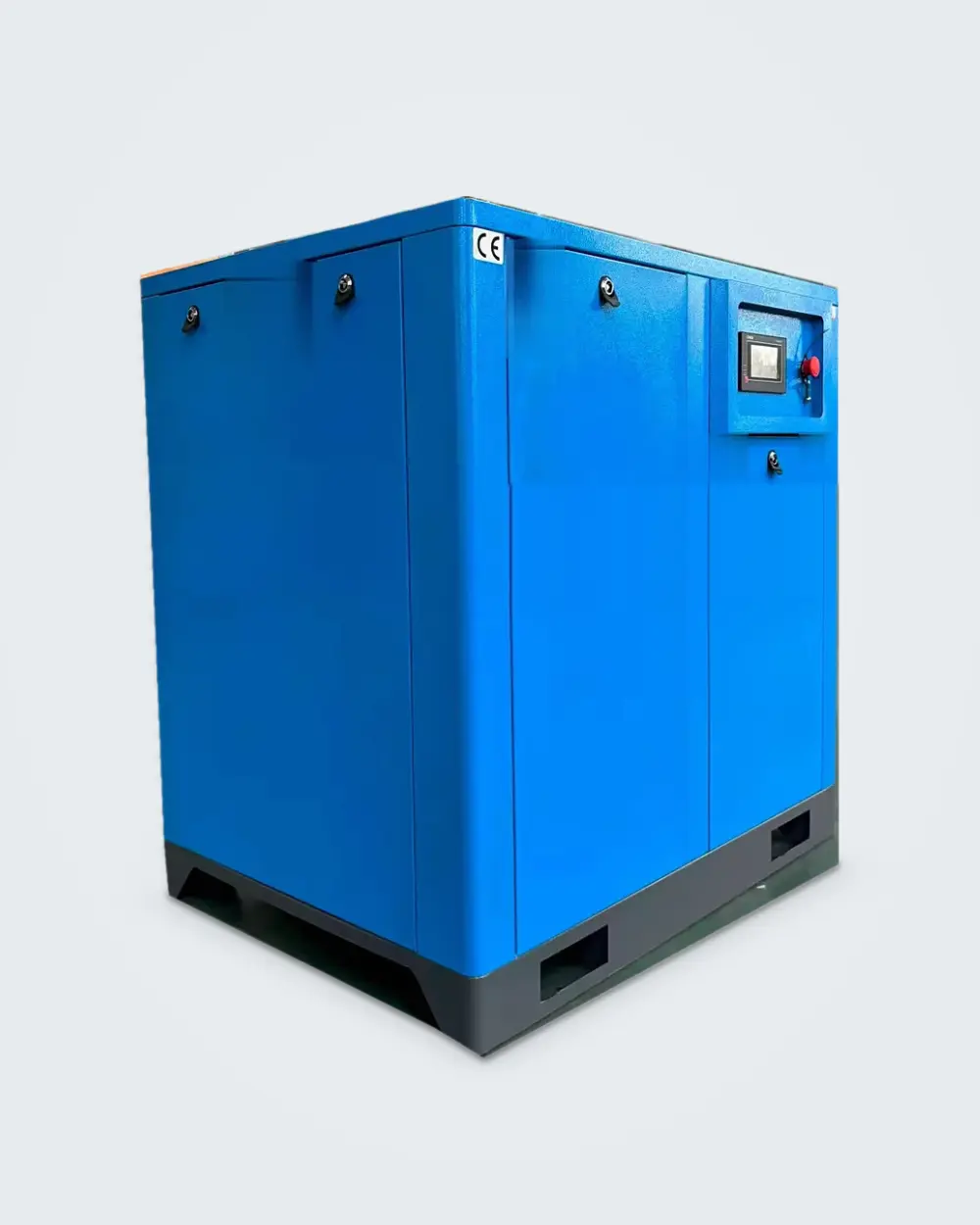 5.5kW
S 55Screw compressor 5.5 kW
The entry-level screw compressor for workshops that run all day long.
 7.5kW
K 75Screw compressor 7.5 kW 4-in-1
Compressor, 420 L air receiver, refrigerated dryer and filtration combined on a single frame.
11kW
K 110Screw compressor 11 kW 4-in-1
Compressor, air receiver, refrigerated dryer and filtration combined on a single frame, at 11 kW.
 15kW
K 150Screw compressor 15 kW 4-in-1
Compressor, air receiver, refrigerated dryer and filtration combined on a single frame, at 15 kW.
Other trades
A project, a question?
We answer quickly and quotes are free. Tell us what you run on air and we'll point you to the right model.