Ceramics and glazing
Compressor for ceramics and glazing
Screw compressor for ceramics and glazing: dry air for spray glazing, presses, slip casting and filter pulse cleaning. Flow worked out, protected air intake.
For a ceramics workshop with one or two glazing booths, a 7.5 kW 4-in-1 screw compressor such as the K 75 (1.1 m³/min at 8 bar, dryer built in) is enough in most cases. A pottery factory or a small tile plant that glazes, presses and pulse-cleans its dust collectors at the same time needs more like 2 to 4 m³/min, which means a K 150 or an S 220 PM. In every case, the air must reach the spray gun dry and filtered, and the compressor must breathe air that is free of ceramic dust.
In ceramics, compressed air is used at almost every stage. It atomises the glaze in the spray booths, operates the tile presses and demoulding, drives water out of the moulds in pressure casting, blows dust off greenware before glazing, cleans dust collector filters with pulses of air and moves the cylinders on transfer lines. This page is for pottery and earthenware factories, tile and sanitaryware manufacturers, roof tile and brick works, and pottery studios and studio ceramics workshops.
How much air does a ceramics workshop need?
Each station has its own profile. Spray glazing uses air continuously while the operator is spraying. Presses and demoulding use air in bursts, on each cycle. Dust collector pulse cleaning sends out short but repeated pulses all day long. The figures below are indicative only; the exact consumption is in the manual for each machine or gun.
| Station | Consumption of around | Profile |
|---|---|---|
| Glaze spray gun in a booth | 200 to 350 l/min | continuous while spraying |
| Tile press, ejection and demoulding | 100 to 200 l/min | per cycle |
| Pressure casting (demoulding, mould purging) | 150 to 300 l/min per bench | per cycle |
| Dust collector pulse cleaning | 150 to 250 l/min | repeated pulses |
| Blow gun for dusting pieces | 150 l/min | intermittent |
| Cylinders on a transfer line | 50 to 150 l/min | per cycle |
Example calculation for a pottery factory
Take a pottery factory running continuously with two glazing booths, two presses, two dust collectors, one line of cylinders and two blow guns:
- 2 glaze spray guns at 300 l/min: 600 l/min
- 2 presses at 150 l/min: 300 l/min
- 2 dust collectors at 200 l/min: 400 l/min
- line cylinders: 150 l/min
- 2 blow guns at 150 l/min, used intermittently and counted at 50%: 150 l/min
- total: 1,600 l/min
Then add the two margins from our configurator: 25% safety for leaks and wear (1,600 × 1.25 = 2,000 l/min), then 20% for a future machine (2,000 × 1.2 = 2,400 l/min). The need is therefore about 2.4 m³/min at 8 bar (roughly 85 CFM). Our flow and pressure converter turns l/min into m³/min and into the CFM used in manuals.
What pressure for glazing and presses?
A glaze spray gun works at low pressure: around 2 to 4 bar at the gun, depending on the viscosity of the glaze and the nozzle. Filter pulse cleaning generally needs 5 to 7 bar for the pulse to shake the dust loose, and the cylinders on presses and lines work at around 6 bar. Set the compressor between 7 and 8 bar, then fit a regulator with a pressure gauge at each booth. Running the network any higher does nothing for the glaze and increases consumption and leaks. Our article on compressor pressure explains this calculation in detail.
Which compressor for ceramics and glazing?
- Pottery studio or studio ceramics workshop, one booth: the S 55, a 5.5 kW screw compressor, delivers 0.6 m³/min at 8 bar at 65 to 68 dB(A). It is completed with an air receiver and a dryer. See our article on the compressor for a pottery studio.
- Workshop with two booths and blow guns: the K 75, a 7.5 kW 4-in-1, delivers 1.1 m³/min at 8 bar. Compressor, 420 L air receiver, refrigerated dryer and filtration come together: the air reaches the gun dry with no system to design.
- Small production unit: the K 150 goes up to 2.2 m³/min at 8 bar, still as a 4-in-1.
- Pottery factory, tile or sanitaryware plant: the S 220 PM, with its permanent magnet motor, delivers 3.6 m³/min at 8 bar and covers the example above with reserve to spare. Beyond that, the S series goes up to 132 kW on quotation, see our compressors from 30 to 132 kW.
The S and K series are variable speed. In ceramics, demand changes all the time: a booth stops while pieces are changed, a press waits for slip, pulse cleaning runs on its own at night. The compressor slows down instead of running off-load. See variable speed or fixed speed.
When a loss of air stops a pressing line or a continuously fed kiln, two compressors taking turns are better than one bigger unit. Our article on the backup compressor explains how to organise them.
Why must the air be dry for glazing?
Air leaves the compressor hot and loaded with water vapour. As it cools in the pipes, this water condenses. At the gun, a drop of water sprayed onto the piece dilutes the glaze locally: a run, an overly thick patch or a poorly covered area that will show after firing. A trace of oil on the bisque stops the glaze from bonding and causes crawling or craters. Glazing is therefore as demanding as spray painting.
The basic treatment is a refrigerated dryer followed by filtration of particles and oil aerosols. Our compressors are lubricated: it is the filtration at the outlet that holds back the oil carried over. At the foot of each booth, a fine filter completes the protection. The air class to aim for under ISO 8573-1 is set with our technicians; our guide to ISO 8573-1 air quality explains how to read it. Air-related glaze faults are covered in our article dry air and glaze defects, and choosing the compressor for the booth in which compressor for spray glazing.
How do you protect the compressor from ceramic dust?
Clay, glaze and silica dust is fine and abrasive. Drawn in by the compressor, it clogs the air filter, fouls the cooler and wears the screw element. The rule is simple: the compressor does not breathe the workshop air.
- A separate room, closed off from production, with an air intake taken from outside or from a clean area. See our guide to the compressor room.
- A protected air intake with a grille and, if needed, a pre-filter, away from dust collector outlets, mills and raw material silos.
- A clean cooler: blow it out regularly with the compressor stopped. A blocked cooler makes the machine overheat.
- A closely watched air filter: check it more often than the standard interval until you know the dust load in your room.
Kilns also give off a lot of heat: do not put the compressor next to them. Our article on ceramic dust and the air intake goes into detail. For the dust collectors themselves, see filter pulse cleaning in a tile factory.
Can you recover the compressor's heat for the dryers?
Yes, and in ceramics it is often worthwhile. A screw compressor turns most of its electricity into heat. Recovered through a duct on the cooling air, it can preheat a greenware dryer or heat a glazing workshop in winter. Our heat recovery calculator estimates the power available, and the heat recovery guide explains the set-up.
How do you maintain the compressor in a ceramics workshop?
- Condensate. An automatic condensate drain on the air receiver and at the low points of the network. This condensate contains oil: it must be collected and treated, and it does not go out with the glaze wash water.
- Leaks. Quick couplings on the booths, blow gun hoses, pulse cleaning solenoid valves: the leak cost calculator puts a figure on them.
- Servicing. First service at 500 hours, then every 1,500 hours, with a reminder shown on the controller. Keep a service kit in stock and a spare air filter. The screw compressor maintenance guide explains each operation in detail. The compressors come with a 2-year warranty and spare parts remain available for 15 years.
For an existing installation that is short of air or uses too much, our technicians carry out a compressed air audit. For a new installation, start with the configurator or send us the list of your booths, presses and dust collectors with a quote request.
Typical tools in this trade
| Tool | Consumption | Typical number |
|---|---|---|
| Paint / varnish spray gun | ≈ 350 l/min | 2 |
| Ceramic press / demoulding | ≈ 150 l/min | 2 |
| Dust collector filter cleaning | ≈ 200 l/min | 2 |
| Machine cylinders and automation | ≈ 100 l/min | 1 |
| Blow gun | ≈ 150 l/min | 2 |
Indicative average consumption. The configurator calculates your exact demand.
AIRSTAHL Lab
Recommended air quality
Painting and finishing — Dry, filtered air for paint and clearcoat spray guns.
Calculate my demand for this tradeFrequently asked questions — Ceramics and glazing
Which compressor for a ceramics workshop with one glazing booth?
For one booth and one blow gun, the need with margins is around 0.5 m³/min: the S 55, 0.6 m³/min at 8 bar, is enough with an air receiver and a dryer. For two booths, or treated air with nothing to assemble, the K 75, a 4-in-1 delivering 1.1 m³/min at 8 bar, is the simplest option.
How much air does a glaze spray gun use?
As a guide, a glaze spray gun uses around 200 to 350 l/min depending on the nozzle and the pressure. It sprays continuously through a batch of pieces: count it at 100% in the calculation. The exact figure is in the gun's manual.
What pressure do you need for spray glazing?
Glaze is sprayed at low pressure, around 2 to 4 bar at the gun depending on viscosity and nozzle. Set the compressor between 7 and 8 bar to cover the losses in the pipework and filters, and fit a regulator with a pressure gauge at each booth.
Can compressed air cause glaze defects?
Yes. Water in the air causes runs and poorly covered areas, oil makes the glaze crawl and creates craters, and unstable pressure gives an uneven coat. A refrigerated dryer, filtration at the outlet and a fine filter at the booth prevent these defects. See dry air and glaze defects.
How do you protect a compressor from ceramic dust?
Install it in a room separate from production, with an air intake taken from outside or from a clean area, protected by a grille and a pre-filter if needed. Keep it away from presses, mills, dust collectors and kilns. Check the air filter and the cooler more often than the standard interval.
How much air for dust collector pulse cleaning in a tile factory?
As a guide, around 150 to 250 l/min per dust collector, in pulses at 5 to 7 bar; the manufacturer's manual gives the exact figure. With four dust collectors, that already comes to about 0.8 m³/min. The air must be dry, otherwise the clay dust forms a crust on the filter bags. See filter pulse cleaning in a tile factory.
Which compressor for a pottery factory or tile plant?
A unit that glazes, presses and pulse-cleans at the same time often needs 2 to 3 m³/min with a 25% safety margin and 20% for expansion. The S 220 PM delivers 3.6 m³/min at 8 bar, and the S series goes up to 132 kW on quotation. Two compressors taking turns protect a line that must not stop.
Can the compressor's heat be used to dry the pieces?
Yes. A screw compressor turns most of its electricity into heat, which can be recovered through a duct on the cooling air to preheat a dryer or heat the glazing workshop. Our heat recovery calculator estimates the power available.
The recommended models
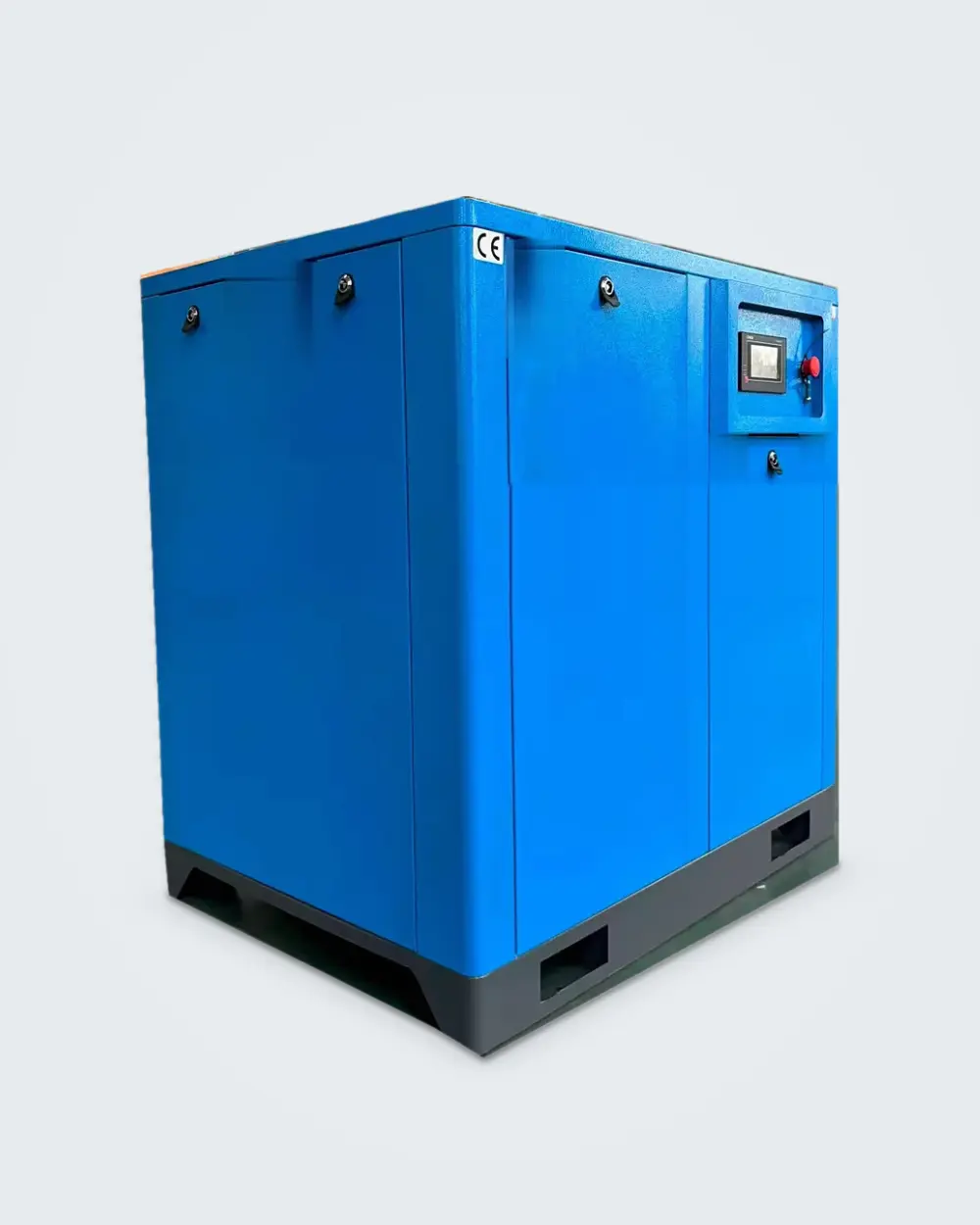 5.5kW
S 55Screw compressor 5.5 kW
The entry-level screw compressor for workshops that run all day long.
 7.5kW
K 75Screw compressor 7.5 kW 4-in-1
Compressor, 420 L air receiver, refrigerated dryer and filtration combined on a single frame.
 15kW
K 150Screw compressor 15 kW 4-in-1
Compressor, air receiver, refrigerated dryer and filtration combined on a single frame, at 15 kW.
 22kW
S 220 PMScrew compressor 22 kW permanent magnet
Permanent magnet motor, 10 bar: the industrial machine of the range.
Other trades
A project, a question?
We answer quickly and quotes are free. Tell us what you run on air and we'll point you to the right model.