Dry cleaning
Compressor for dry cleaners and dry cleaning shops
Compressor for dry cleaners: pneumatic ironing press, form finisher, topper, spotting gun. Flow worked out, dry filtered air with no stains, a quiet model.
A high-street dry cleaner with one ironing press, a form finisher, a trouser topper and a spotting table uses around 350 l/min at busy times, or about 530 l/min once the configurator's margins are added. A 5.5 kW screw compressor such as the S 55 (0.6 m³/min at 8 bar) or a 7.5 kW 4-in-1 such as the K 75 (1.1 m³/min) covers that need. The air must reach the spotting gun and the press dry and filtered, and the compressor has to stay quiet if it sits close to the shop counter.
What is compressed air used for in a dry cleaner's?
In a dry cleaner's, the steam comes from the steam generator and the cleaning itself from the solvent machine or the wet cleaning machine. Compressed air is what makes things move:
- The pneumatic ironing press: a cylinder closes and opens the press head onto the buck.
- The form finisher and the topper: pneumatic clamps and tensioners hold the shirt, jacket or trousers while steam and hot air pass through.
- The spotting gun on the spotting table: it blows onto the stain to drive off the chemical and dry the area.
- The pneumatic valves on some dry cleaning machines and some steam generators.
- The clamps and blow guns in the alterations room.
The air touches the garment at the spotting gun and, often, at the press. A drop of water or a trace of oil on a white shirt shows straight away and costs you a re-do, sometimes a customer.
If you run an industrial laundry, with tunnel washers, folders and flatwork ironers, see our page on the compressor for textiles and laundries instead: the flows and the machines there are on another scale.
How much air does a dry cleaner's need?
The need is worked out from each machine's manual: the manufacturer gives the air consumption in l/min and the working pressure. The figures below are indicative only.
| Machine | Consumption of around | Usual pressure | How it is used |
|---|---|---|---|
| Pneumatic ironing press | 100 to 300 l/min during the cycle | 5 to 6 bar | continuously at busy times |
| Form finisher or topper (clamps, tensioners) | 50 to 100 l/min | 5 to 6 bar | intermittently |
| Spotting gun | 100 to 150 l/min while it is blowing | 3 to 6 bar | intermittently |
| Valves on the dry cleaning machine and steam generator | 20 to 50 l/min | 6 bar | intermittently |
| Alterations blow gun | 150 l/min | 6 bar | intermittently |
Tools used intermittently are counted at 50%, because the air receiver supplies the peaks. Then add a 25% safety margin, followed by 20% for one more machine, just as our configurator does.
Example of a high-street dry cleaner:
- Ironing press: 200 l/min, counted at 100%.
- Topper with clamps: 80 l/min, counted at 50%, so 40 l/min.
- Spotting gun: 120 l/min, counted at 50%, so 60 l/min.
- Valves on the dry cleaning machine and steam generator: 50 l/min.
- Total: 350 l/min.
- With a 25% safety margin: 350 × 1.25 = 437.5 l/min.
- With 20% for one more machine: 437.5 × 1.2 = 525 l/min, or about 0.53 m³/min (roughly 19 CFM).
The compressor is set at 8 bar to keep 6 bar at the far end of the network, after the dryer and the filters. Our flow and pressure converter turns l/min into m³/min or CFM if your manuals use other units. The detailed press calculation is in our article pneumatic ironing press: air consumption and pressure.
Which compressor for a dry cleaner's?
A dry cleaner's is open all day, and its machines call for air in waves: a variable speed screw compressor follows those waves without constantly starting and stopping. Our article which compressor for a dry cleaner's compares the cases in detail.
- High-street dry cleaner, one press and one spotting table: the S 55, a 5.5 kW screw compressor, 0.6 m³/min at 8 bar, 65 to 68 dB(A). It covers the example above. Supplied without an air receiver, it is completed with an air receiver, a dryer and a fine filter.
- Dry cleaner with two pressing stations, or if you want a single machine to set down: the K 75, a 7.5 kW 4-in-1, 1.1 m³/min at 8 bar, with a 420 L air receiver, refrigerated dryer and filtration built in, 66 ± 2 dB(A).
- Central finishing plant for a dry cleaning chain, with several presses, form finishers and spotting tables: the K 110, an 11 kW 4-in-1, 1.7 m³/min at 8 bar, with a 340 L air receiver.
An example of a central plant: three presses at 200 l/min (600 l/min), two toppers counted at 40 l/min (80 l/min), two spotting guns counted at 60 l/min (120 l/min) and the valves on two machines (100 l/min). Total: 900 l/min, then 1,125 l/min with 25% and 1,350 l/min with 20%. The K 110 and its 1,700 l/min cover this need.
All our compressors run on 380 V three-phase. In a shop, check the electrical supply with your electrician before ordering.
What air quality for spotting and pressing?
Our screw compressors are lubricated. As it leaves the screw element, the air contains water, particles and a few ppm of oil (3 to 5 ppm according to the S series data sheets). For a dry cleaner's, the treatment chain is as follows:
- A refrigerated dryer: it removes the water, the main cause of stains and water marks.
- A general-purpose filter followed by a fine filter: they stop particles and oil aerosols.
- An activated carbon filter at the point of use on the spotting gun, which blows straight onto the fabric.
- Automatic condensate drains on the air receiver, the dryer and the filters.
The air class to aim for under ISO 8573-1 is defined with our technicians. Our guide to ISO 8573-1 air quality explains these classes, and our article on the spotting gun covers the most sensitive station in detail. If stains are already appearing, follow the method in our article stains on garments at the dry cleaner's.
Where should a dry cleaner's compressor go?
The shop floor, the back room and the basement each bring their own constraints:
- Noise. A canopied screw compressor is quieter than a piston unit, but it can still be heard at the counter. A partition and a door between the machine and the shop do more than a few metres of distance. Our article quiet compressor in a shop or basement sets out the rules.
- Heat. A dry cleaner's is a hot place: steam generator, presses, tumble dryers. Put the compressor away from these heat sources, in a ventilated room. Intake air that is too hot makes the dryer work harder.
- Solvent vapours. Do not let the compressor draw its air from the area around the dry cleaning machine. If your machine uses a flammable solvent, have your installer check the zones where the compressor must not be placed.
- Condensate. It contains oil: it has to be collected and treated, not poured down the sink. Our condensate volume calculator estimates the quantity.
What maintenance does a dry cleaner's compressor need?
First service at 500 hours, then every 1,500 hours: the controller displays the reminder. Lint and steam quickly clog the intake filter and the cooler, so check them more often. Replace the fine filter cartridges when they are due: a saturated filter no longer protects the garments. The service kits bring together the parts for each model. 2-year warranty, spare parts available for 15 years.
To choose your compressor, enter your machines in the configurator, then send the list of your presses, form finishers and spotting tables with a quote request.
Typical tools in this trade
| Tool | Consumption | Typical number |
|---|---|---|
| Pneumatic ironing press | ≈ 200 l/min | 1 |
| Form finisher or topper (pneumatic clamps) | ≈ 80 l/min | 1 |
| Spotting gun (spotting table) | ≈ 120 l/min | 1 |
| Machine cylinders and automation | ≈ 100 l/min | 1 |
Indicative average consumption. The configurator calculates your exact demand.
AIRSTAHL Lab
Recommended air quality
Painting and finishing — Dry, filtered air for paint and clearcoat spray guns.
Calculate my demand for this tradeFrequently asked questions — Dry cleaning
Which compressor for a high-street dry cleaner's?
One ironing press, one topper and one spotting table need around 350 l/min, or about 525 l/min with the configurator's 25% and 20% margins. The S 55, a 5.5 kW screw compressor, delivers 0.6 m³/min at 8 bar and covers this need, with an air receiver, a dryer and a fine filter. If you want a single machine to set down, or a second press is planned, the K 75 4-in-1 delivers 1.1 m³/min.
How much air does a pneumatic ironing press use?
As a guide, around 100 to 300 l/min while it runs cycle after cycle, depending on the type: utility press, collar and cuff press, trouser press or double-buck press. If the manual gives a volume per cycle, multiply it by the number of cycles per minute at busy times. The exact figure is in your press's manual.
What pressure does an ironing press need?
Most presses need 5 to 6 bar at their inlet. Set the compressor at around 8 bar to make up for the losses in the dryer, the filters and the pipework. Going higher does not improve the pressing and increases leaks around the hoses.
What air does a spotting gun need?
The gun uses around 100 to 150 l/min while it is blowing, at 3 to 6 bar set on the table's regulator. Because it blows onto the fabric, the air must be dry and filtered: refrigerated dryer, fine filter, then an activated carbon filter at the station. Our article on the spotting gun sets out the chain in detail.
Can a lubricated compressor stain garments?
Our screw compressors are lubricated: at the outlet, the air still contains 3 to 5 ppm of oil according to the S series data sheets. With a dryer, a fine filter, an activated carbon filter at the gun and drains that work, this oil and the water are held back before they reach the garment. The ISO 8573-1 air class to aim for is defined with our technicians.
How loud is a compressor for a dry cleaner's?
The S 55 is rated at 65 to 68 ± 2 dB(A) and the K 75 at 66 ± 2 dB(A). A canopied screw compressor is quieter than a piston unit, which can be heard every time it starts. The biggest gain comes from a partition and a door between the compressor and the counter: see our article quiet compressor in a shop.
Can the compressor go in a dry cleaner's basement?
Yes, provided the room is ventilated: a 5.5 kW compressor gives off about 5.5 kW of heat at full load. You need a fresh air inlet low down, a hot air outlet high up, a dry, frost-free room, and enough clearance to get the machine down and service it. Condensate, which contains oil, must be collected and not poured down the sink.
How is it different from an industrial laundry compressor?
A dry cleaner's runs a few presses, form finishers and spotting tables, generally less than 1.5 m³/min with margins. An industrial laundry adds tunnel washers, extraction presses and folders, and quickly goes beyond this flow. For that case, see our page on the compressor for textiles and laundries.
The recommended models
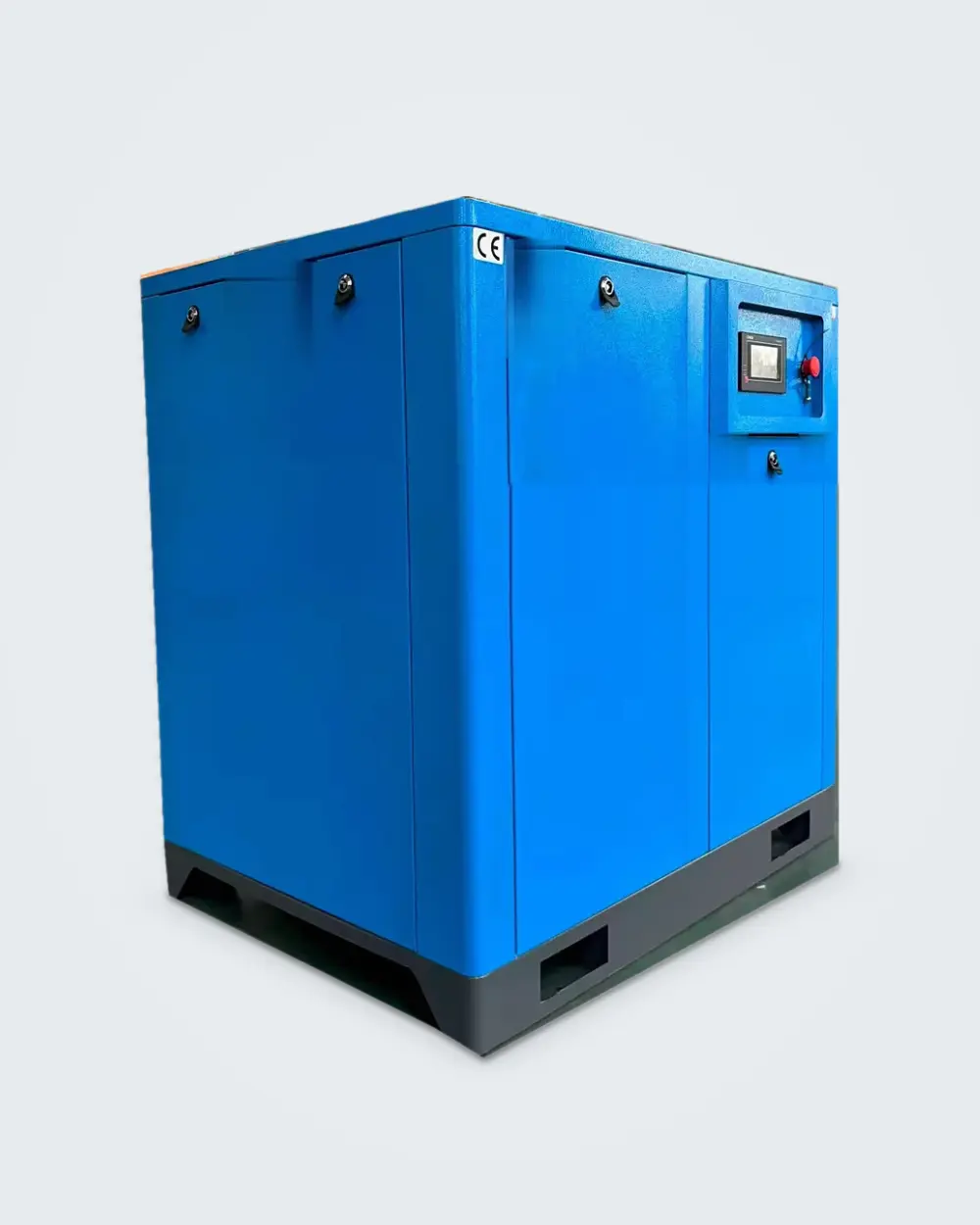 5.5kW
S 55Screw compressor 5.5 kW
The entry-level screw compressor for workshops that run all day long.
 7.5kW
K 75Screw compressor 7.5 kW 4-in-1
Compressor, 420 L air receiver, refrigerated dryer and filtration combined on a single frame.
11kW
K 110Screw compressor 11 kW 4-in-1
Compressor, air receiver, refrigerated dryer and filtration combined on a single frame, at 11 kW.
Other trades
A project, a question?
We answer quickly and quotes are free. Tell us what you run on air and we'll point you to the right model.