Aerospace
Compressor for aerospace, aircraft maintenance and subcontracting
Aerospace air compressor for MRO, subcontractors and flying clubs. Rivet guns, air drills, composite sanding, painting. Dry, filtered air to ISO 8573-1.
An aircraft maintenance workshop or a medium-sized aerospace subcontractor usually needs 1 to 2 m³/min of dry, filtered air at 7 to 8 bar. An 11 kW 4-in-1 screw compressor such as the K 110, which delivers 1.7 m³/min (about 60 CFM) at 8 bar with a built-in dryer and filtration, covers a workshop where four people are drilling, riveting, sanding and painting at the same time. A flying club hangar often manages with a K 75 at 1.1 m³/min, while a subcontracting line running several shifts moves up to the S 220 PM, with a second compressor as backup.
What is compressed air used for in an aerospace workshop?
Aerospace uses compressed air at almost every stage, from making parts to maintaining them:
- Structural assembly: angle and straight air drills, rivet guns, blind rivet tools, deburring tools, screwdrivers and assembly tooling.
- Composites: orbital and angle sanders for preparing laminates, trimming, and repairs to panels and fairings.
- Painting and surface preparation: primer and topcoat spray guns, blowing down before painting, bead blasting and gentle paint stripping in a booth.
- Machining subcontractors: machining centres, sheet metal work, presses, surface treatment lines where air operates the valves and agitates the tanks.
- Line and hangar maintenance: tyre inflation, blowing down, dismantling tools, test benches.
One compressor therefore supplies very different tools, with two requirements in common: a flow rate that holds up when several stations are working at once, and air whose quality is known and documented.
How much air do the tools in an aerospace workshop use?
The figures below are indicative only, for a working pressure of around 6.3 bar. The exact consumption is in each tool's manual.
| Tool | Indicative consumption | How it is used |
|---|---|---|
| Air drill | roughly 300 to 450 l/min | in bursts |
| Rivet gun | roughly 100 to 200 l/min | in bursts |
| Pneumatic-hydraulic blind rivet tool | roughly 1 to 2 litres per rivet | in bursts |
| Orbital sander for composites | roughly 300 to 400 l/min | continuous |
| Paint or primer spray gun | roughly 250 to 400 l/min | continuous |
| Bead blasting cabinet | roughly 500 to 1,500 l/min depending on the nozzle | continuous |
| Blow gun | roughly 150 l/min | in bursts |
What weighs heavily is the tools that run continuously: the sander, the spray gun and the bead blaster. Drills and rivet guns use a lot of air, but in bursts, and the air receiver smooths out those demands. The detail tool by tool is in our article on air consumption of rivet guns and air drills.
How do you size the compressor for a maintenance workshop?
Take a maintenance workshop with four technicians working at the same time: one sanding a composite repair, one painting in the booth, and two drilling and riveting on a structure.
- Sander: 350 l/min, continuous, counted in full.
- Spray gun: 350 l/min, continuous, counted in full.
- Two drills: 2 × 400 l/min, but in bursts. The air receiver absorbs the peaks, so they count at half: 400 l/min.
- Subtotal: 350 + 350 + 400 = 1,100 l/min.
- 25% safety margin for leaks and tool wear: 1,100 × 1.25 = 1,375 l/min.
- 20% expansion margin for one more station: 1,375 × 1.2 = 1,650 l/min, or 1.65 m³/min.
These are the margins our configurator applies. The result points to the K 110, at 1.7 m³/min at 8 bar. Our flow and pressure converter turns the CFM figures in tool manuals into l/min.
Which compressor should an aerospace workshop choose?
- Flying club hangar, small maintenance workshop: the K 75, a 7.5 kW 4-in-1 screw compressor, delivers 1.1 m³/min at 8 bar. Compressor, 420 L air receiver, refrigerated dryer and filtration share one frame, so the air reaches the workshop dry with no system to design. If all you do is inflate tyres, blow down and drill a few holes, the S 55 at 0.6 m³/min is enough, with a separate receiver and dryer.
- Maintenance workshop with 3 to 5 technicians, single-shift subcontractor: the K 110 at 1.7 m³/min, or the K 150 at 2.2 m³/min if a spray booth and sanding run all day.
- Subcontractor on two or three shifts, machining and assembly: the S 220 PM, with its permanent magnet motor, delivers 3.6 m³/min at 8 bar. Beyond that, the S series goes up to 132 kW on quotation: see our industrial compressors from 30 to 132 kW.
The S and K series are variable speed. In a workshop where someone drills for a minute, sands for ten, then stops to inspect, demand changes all the time: the compressor follows it instead of switching between load and idle. The detailed choice by workshop size is in our article which compressor for an aircraft maintenance workshop.
What air quality do aerospace customers require?
In aerospace, air quality is not a matter of convenience. A drop of water or a film of oil under a coat of paint means an adhesion defect that can show up months later. On a composite, a contaminated surface compromises a bond or a repair. That is why prime contractors' specifications and product data sheets increasingly set an air quality class to ISO 8573-1.
The class is written as three digits: particles, water, oil. For water, class 4 corresponds to a pressure dew point of +3 °C, which a refrigerated dryer achieves; class 2 corresponds to -40 °C, which a desiccant dryer achieves. For oil, class 1 limits the content to 0.01 mg/m³.
Our screw compressors are oil-lubricated. Carried-over oil is captured by the filtration at the outlet, and for painting or surface preparation air you add fine filters and an activated carbon filter at the point of use. The class to achieve is defined with our technicians, based on your specification. See our guide to ISO 8573-1 air quality and the article on dry, clean air for aerospace painting.
How should you handle composite sanding?
Sanding carbon and glass fibre laminates produces a fine, irritating dust which, in the case of carbon, conducts electricity. Two rules: work with dust-extracting sanders connected to a dust extractor, and keep that dust away from the compressor. An air intake that draws in carbon dust clogs the intake filter and can reach electrical components. Sander consumption and how to organise dust extraction are covered in our article on sanding composites with compressed air.
How do you keep the air on at a subcontractor?
For a subcontractor, losing air means a late delivery and a non-conformance to explain. Two compressors taking turns are better than one bigger unit: if one is being serviced, the other keeps production going. Compressor hire from 5.5 to 132 kW can cover a breakdown or a peak in workload. For a customer audit, keep a maintenance log and dew point records. Our technicians can carry out a compressed air audit of your installation. See our article on keeping compressed air on at an aerospace subcontractor.
Installation and maintenance
- The room. Separate from the sanding area and the spray booth, ventilated, with a clean air intake. See our article on the compressor room.
- Condensate. An automatic condensate drain on the receiver and at the low points. This condensate contains oil: it must be collected and treated.
- Servicing. First service at 500 hours, then every 1,500 hours. Keep a service kit in stock and record every intervention: that is the basis of traceability. Compressors carry a 2-year warranty and parts remain available for 15 years.
To size your installation, start with the configurator, or send us the list of your tools and your customers' specifications with a quote request.
Typical tools in this trade
| Tool | Consumption | Typical number |
|---|---|---|
| Pneumatic drill (structural assembly) | ≈ 400 l/min | 3 |
| Pneumatic rivet hammer | ≈ 150 l/min | 3 |
| Orbital sander | ≈ 350 l/min | 1 |
| Paint / varnish spray gun | ≈ 350 l/min | 1 |
| Blow gun | ≈ 150 l/min | 2 |
| Tyre inflator (cars) | ≈ 100 l/min | 1 |
Indicative average consumption. The configurator calculates your exact demand.
AIRSTAHL Lab
Recommended air quality
Painting and finishing — Dry, filtered air for paint and clearcoat spray guns.
Calculate my demand for this tradeFrequently asked questions — Aerospace
Which compressor for an aircraft maintenance workshop?
A workshop with four technicians drilling, sanding and painting at the same time needs around 1.65 m³/min including the safety and expansion margins. The K 110, an 11 kW 4-in-1 screw compressor, delivers 1.7 m³/min at 8 bar with a built-in dryer and filtration. A flying club workshop often manages with a K 75 at 1.1 m³/min.
How much air does an air drill use?
As a rough guide, an air drill uses around 300 to 450 l/min at 6.3 bar while it is running. Because it works in bursts, it counts at half in the calculation, with the air receiver supplying the peaks. The exact consumption is in the tool's manual.
How much air does a rivet gun use?
A rivet gun uses around 100 to 200 l/min in bursts of a few seconds. A pneumatic-hydraulic blind rivet tool uses only around 1 to 2 litres per rivet, which is almost nothing. Check the figures in your tool manuals.
Which ISO 8573-1 air class is needed for aerospace painting?
The class is set by the prime contractor's specification or the product data sheet. It is written as three digits (particles, water, oil): water class 4 corresponds to a dew point of +3 °C, class 2 to -40 °C. Our technicians define the treatment to install with you. See our guide to ISO 8573-1 air quality.
Is an oil-lubricated compressor suitable for painting and bonding?
Yes, provided the air is treated. Our screw compressors are oil-lubricated and carried-over oil is captured by the outlet filtration. For painting and surfaces to be bonded, add fine filters and an activated carbon filter at the point of use, with no lubricator on that line.
Refrigerated or desiccant dryer for an aerospace workshop?
The refrigerated dryer, built into the K series 4-in-1 compressors, gives a dew point of around +3 °C, which is enough in a heated building. The desiccant dryer gets down to -40 °C: choose it when the specification requires it or when a pipe runs through a cold hangar. It uses part of the air to regenerate, which must be included in the flow.
How do you protect the compressor from composite sanding dust?
Install the compressor in a separate room, with an air intake on the clean side of the building, and extract the dust at source on the sanders. Carbon dust clogs the intake filter, fouls the cooler and, being conductive, can disrupt electrical components. Check the air filter more often than the standard interval if the environment is dusty.
How do you avoid losing air at an aerospace subcontractor?
Split the demand across two screw compressors that take turns, each able to cover essential production on its own, for example two S 150 units at 2.2 m³/min. Service one while the other produces, at 500 hours then every 1,500 hours, and keep a maintenance log for audits. Our technicians can carry out a compressed air audit of your installation.
The recommended models
 7.5kW
K 75Screw compressor 7.5 kW 4-in-1
Compressor, 420 L air receiver, refrigerated dryer and filtration combined on a single frame.
11kW
K 110Screw compressor 11 kW 4-in-1
Compressor, air receiver, refrigerated dryer and filtration combined on a single frame, at 11 kW.
 15kW
K 150Screw compressor 15 kW 4-in-1
Compressor, air receiver, refrigerated dryer and filtration combined on a single frame, at 15 kW.
 5.5kW
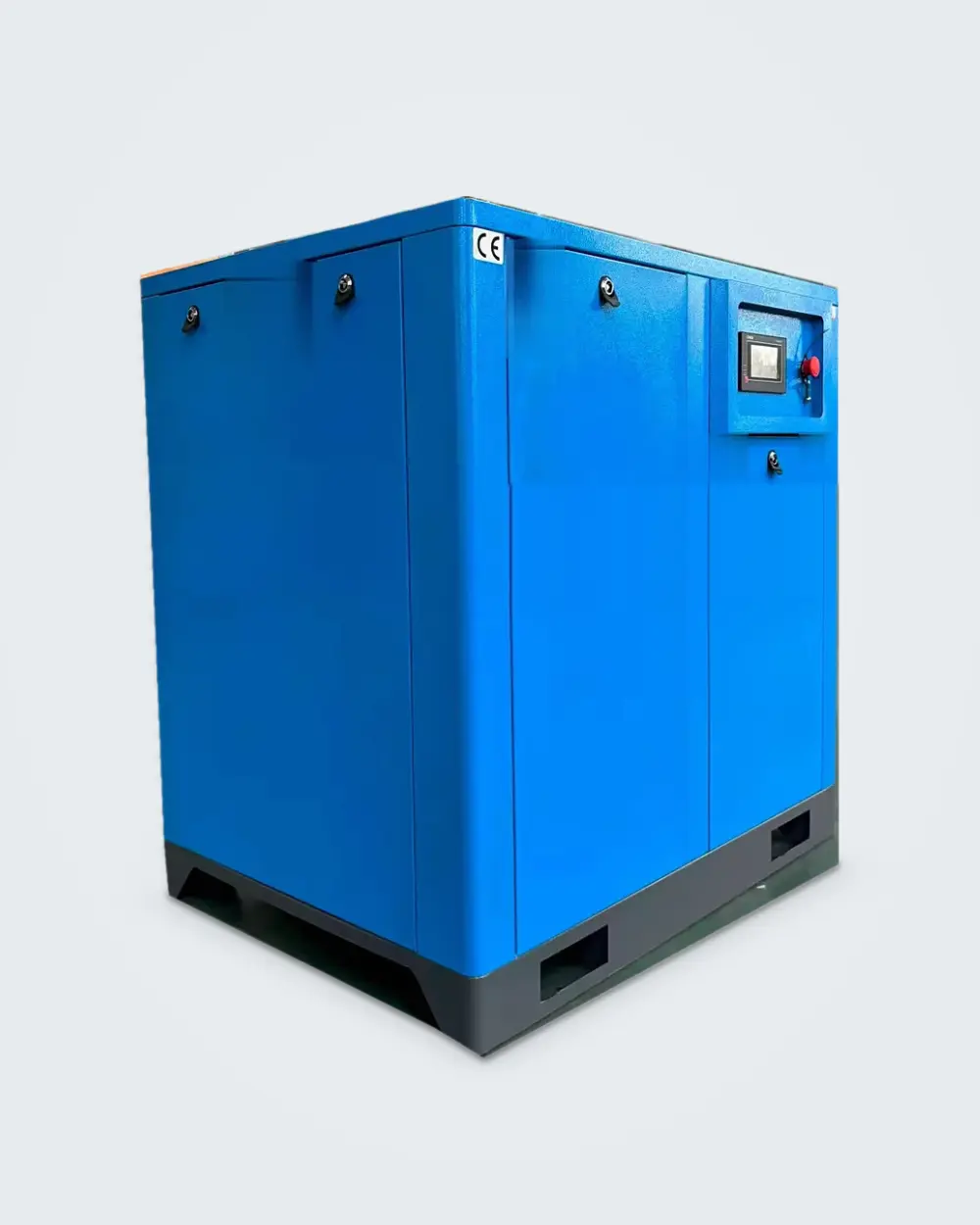
S 55Screw compressor 5.5 kW
The entry-level screw compressor for workshops that run all day long.
 22kW
S 220 PMScrew compressor 22 kW permanent magnet
Permanent magnet motor, 10 bar: the industrial machine of the range.
Other trades
A project, a question?
We answer quickly and quotes are free. Tell us what you run on air and we'll point you to the right model.