Stonemasonry and memorial masonry
Compressor for stonemasons, memorial masons and worktop fabricators
Air compressor for stonemasons and memorial masons - carving hammers, sandblast engraving, wet polishers, vacuum lifters. Air flow worked out, 5.5 to 22 kW.
A stone workshop that sandblasts lettering, wet polishes and carves with a pneumatic hammer all at the same time needs about 2 m³/min (around 70 CFM) at 8 bar: a 15 kW 4-in-1 screw compressor such as the K 150, which delivers 2.2 m³/min with a built-in dryer and filtration, covers this case. A stonemason or sculptor working with one or two hammers manages with 0.6 to 1.1 m³/min, which means an S 55 or a K 75. It is sandblast engraving and wet polishers that push the demand up, not the hammers.
In a stone workshop, compressed air does a great many jobs. It strikes in carving hammers and chisels, it turns sanders and wet polishers, and it fires the abrasive that cuts the lettering of a memorial through the stencil. It creates the vacuum in the suction pads and lifters that raise granite and quartz slabs, it operates the valves on cutting machines and blows dust off finished pieces. And it has to do all this in workshop air laden with stone dust, which changes the way the compressor is installed.
How much air do stonemasonry tools use?
The values below are orders of magnitude, given as a rough guide, for a working pressure of about 6 bar. The exact consumption of each tool is in its manual or on its rating plate.
| Tool | Indicative consumption | Use |
|---|---|---|
| Pneumatic carving or sculpting hammer, chisel | around 150 to 400 l/min | almost continuous during carving |
| Pneumatic wet sander or polisher | around 500 to 900 l/min | continuous during polishing |
| Sandblast engraving, 3 mm nozzle | around 500 to 600 l/min | continuous during engraving |
| Sandblast engraving, 4 mm nozzle | around 900 to 1,000 l/min | continuous during engraving |
| Venturi vacuum pad or lifter | around 50 to 200 l/min | as long as the load is held |
| Valves and cylinders on a cutting machine | around 50 to 150 l/min | intermittent |
| Blow gun | around 150 l/min | intermittent |
Two remarks. Sandblast engraving uses more than everything else: the nozzle size decides the compressor, and the nozzle widens as it wears. Wet polishers, for their part, run for long periods without stopping: they are counted at 100%, not at half like a blow gun.
How do you size the compressor for a stone workshop?
Add up the tools that run at the same time, then add 25% as a safety margin and 20% for future expansion, as our configurator does.
Example of a memorial masonry workshop where three people work together: one is engraving a granite headstone with a 3 mm nozzle, another is polishing a worktop with a wet polisher, and the third is carving with a hammer.
- Engraving, 3 mm nozzle: 600 l/min.
- Wet polisher: 600 l/min.
- Carving hammer: 200 l/min.
- Subtotal: 1,400 l/min.
- 25% safety margin: 1,400 × 1.25 = 1,750 l/min.
- 20% expansion margin: 1,750 × 1.2 = 2,100 l/min, or 2.1 m³/min.
The K 150 delivers 2.2 m³/min at 8 bar: it covers this need. If the workshop moves to a 4 mm nozzle, engraving alone rises towards 1,000 l/min and the total with margins reaches about 2.7 m³/min: you then need the S 220 PM. Our flow and pressure converter switches between l/min, m³/min and the CFM given in manuals.
Which compressor for a stone workshop or a carving shop?
- Sculptor or stonemason working alone, one hammer and a blow gun. The S 55, a 5.5 kW screw compressor, delivers 0.6 m³/min at 8 bar at 65 to 68 dB(A). Pair it with an air receiver and a dryer. For very occasional use, a piston compressor from the E series, on quote, is an alternative.
- Carving shop with two to three hammers, or a small stone workshop without sandblast engraving. The K 75, a 7.5 kW 4-in-1 screw compressor, delivers 1.1 m³/min at 8 bar. The 420 L air receiver, refrigerated dryer and filtration are on the same frame.
- Stone workshop that engraves, polishes and carves at the same time. The K 150, 2.2 m³/min at 8 bar, as in the example.
- Granite and quartz worktop fabrication, several polishers, engraving with a 4 mm nozzle. The S 220 PM, 22 kW with a permanent magnet motor, delivers 3.6 m³/min at 8 bar. Beyond that, the S series goes up to 132 kW, on quote.
The S and K series are variable speed. In a stone workshop, demand changes constantly: an engraving starts, a polisher stops, a lifter holds a slab. The compressor follows these variations instead of switching between load and idle.
For restoration work on a historic monument, away from the workshop, the mobile compressors of the M series move on wheels, and screw compressor hire from 5.5 to 132 kW covers a campaign of a few months.
What air quality for engraving and polishing?
Air leaves the compressor hot and humid. As it cools in the network, the water condenses. In a sandblast engraving cabinet, this water makes the abrasive clump, blocks the nozzle and produces uneven engraving. In a hammer or a polisher, it washes out the lubricant and rusts the mechanism. The fact that the polisher works with water changes nothing: the irrigation water runs through a separate circuit, and the motor air must stay dry.
The basics are a refrigerated dryer and particle and oil aerosol filtration, already built into the K series. Our compressors are lubricated: the outlet filtration holds back the carried-over oil. On pale, porous stones, such as white marble or limestone, a trace of oil or water blown onto the piece can stain: add fine filters at the engraving and blow-off stations.
What should you do about stone dust around the compressor?
Carving, dry sanding and engraving give off a fine dust, often rich in silica with granite, sandstone and quartz. The compressor draws in the air of the room it stands in: if it is in the workshop, it draws in that dust too.
- Install it in a separate room, ventilated, with an air intake on the clean side, away from the engraving cabinet and the sanding stations. See our article on the compressor room.
- Keep an eye on the intake filter. A clogged air filter cuts the air flow and makes the machine run hot.
- Clean the cooler: fins covered in dust make the compressor overheat.
- Never blow dust off yourself or your clothes with the blow gun.
Our article on silica dust and the compressor sets out these precautions in detail.
Our articles for the stone trades
- Which compressor for stone carving? Hammers, chisels and bush hammers: air flow and pressure.
- Sandblast engraving on stone and granite: choosing the nozzle and the air flow.
- Pneumatic wet polishers: air flow and dry air.
- Vacuum pads and lifters for handling slabs.
- Silica dust and the compressor: protecting the machine and the network.
Installation and servicing
- Condensate. Fit an automatic condensate drain on the air receiver and at the low points of the network. This condensate contains oil: collect and treat it, and do not mix it with the polishing water.
- Servicing. First service at 500 hours, then every 1,500 hours. In a dusty environment, check the air filter between service intervals. Keep a service kit in reserve and follow the screw compressor maintenance guide. The compressors carry a 2-year warranty and parts remain available for 15 years.
- The pipework. A hose that is too narrow or too long loses pressure at the engraving nozzle. Check it with the pressure drop calculator.
To size your workshop, enter your tools in the configurator, or send us the list of your stations with a quote request.
Typical tools in this trade
| Tool | Consumption | Typical number |
|---|---|---|
| Pneumatic stone carving hammer / chisel | ≈ 250 l/min | 2 |
| Pneumatic wet polisher / sander (stone) | ≈ 600 l/min | 1 |
| Stone sandblast engraving, 3 mm nozzle | ≈ 600 l/min | 1 |
| Venturi vacuum lifter / suction cups | ≈ 150 l/min | 1 |
| Blow gun | ≈ 150 l/min | 2 |
Indicative average consumption. The configurator calculates your exact demand.
AIRSTAHL Lab
Recommended air quality
Painting and finishing — Dry, filtered air for paint and clearcoat spray guns.
Calculate my demand for this tradeFrequently asked questions — Stonemasonry and memorial masonry
Which compressor for a stonemason's or memorial mason's workshop?
It all depends on which tools run at the same time. A workshop that sandblasts with a 3 mm nozzle, wet polishes and carves with a hammer simultaneously needs about 2.1 m³/min with the margins: the K 150, 2.2 m³/min at 8 bar, is suitable. Without simultaneous engraving or polishing, a K 75 delivering 1.1 m³/min is often enough.
How much air does a pneumatic stone carving hammer use?
As a rough guide, around 100 to 200 l/min for a small sculpting or lettering hammer, 200 to 300 l/min for a medium carving hammer and 300 to 400 l/min for a large hammer or a bush hammer, at about 6 bar. Since it strikes almost without interruption, it is counted at 100% in the calculation. The exact value is in the hammer's manual.
What air flow do you need to sandblast granite?
The nozzle decides: around 500 to 600 l/min for a 3 mm nozzle and 900 to 1,000 l/min for a 4 mm nozzle, at 6 or 7 bar. With a 25% safety margin and 20% for expansion, a 3 mm nozzle needs about 1 m³/min (K 75) and a 4 mm nozzle about 1.5 m³/min (K 110). A 3 mm nozzle worn to 4 mm uses almost twice as much.
What pressure for sandblast engraving on stone?
As a rough guide, granite and hard stones are engraved at around 5 to 7 bar at the nozzle, marble and limestone rather at around 3 to 5 bar to spare the stencil. Set the compressor to about 8 bar and adjust at the station with a regulator. Always run a test on an offcut of the same stone.
Does a wet polisher need dry air?
Yes. The irrigation water runs through a separate circuit, but the air passes through the motor: condensed water washes out the lubricant, rusts the vanes and costs speed. A refrigerated dryer, built into the K series, and an automatic drain on the air receiver are the basics. A polisher uses around 500 to 900 l/min continuously.
How much air does a venturi vacuum lifter use?
Around 50 to 200 l/min per ejector, continuously as long as the slab is held, generally with 5 to 6 bar at the inlet. Rough or porous stone makes it use more. For safety, fit a non-return valve and a small dedicated air receiver before the lifter, and follow the manufacturer's manual.
How do you protect the compressor from stone dust?
Install it in a separate, ventilated room, with an air intake on the clean side, away from the engraving cabinet and the dust extractor. Check the air filter every week and clean the cooler every month, with the machine stopped. The basic servicing remains at 500 hours, then every 1,500 hours.
Screw or piston compressor for stone carving?
A piston unit can be enough for a sculptor working a few hours a week. As soon as hammers, polishers or engraving run for long periods, a screw compressor is better suited: it handles continuous running, and our variable speed S and K series slow down when demand falls. The S 55, 0.6 m³/min at 8 bar, covers a stonemason working alone.
The recommended models
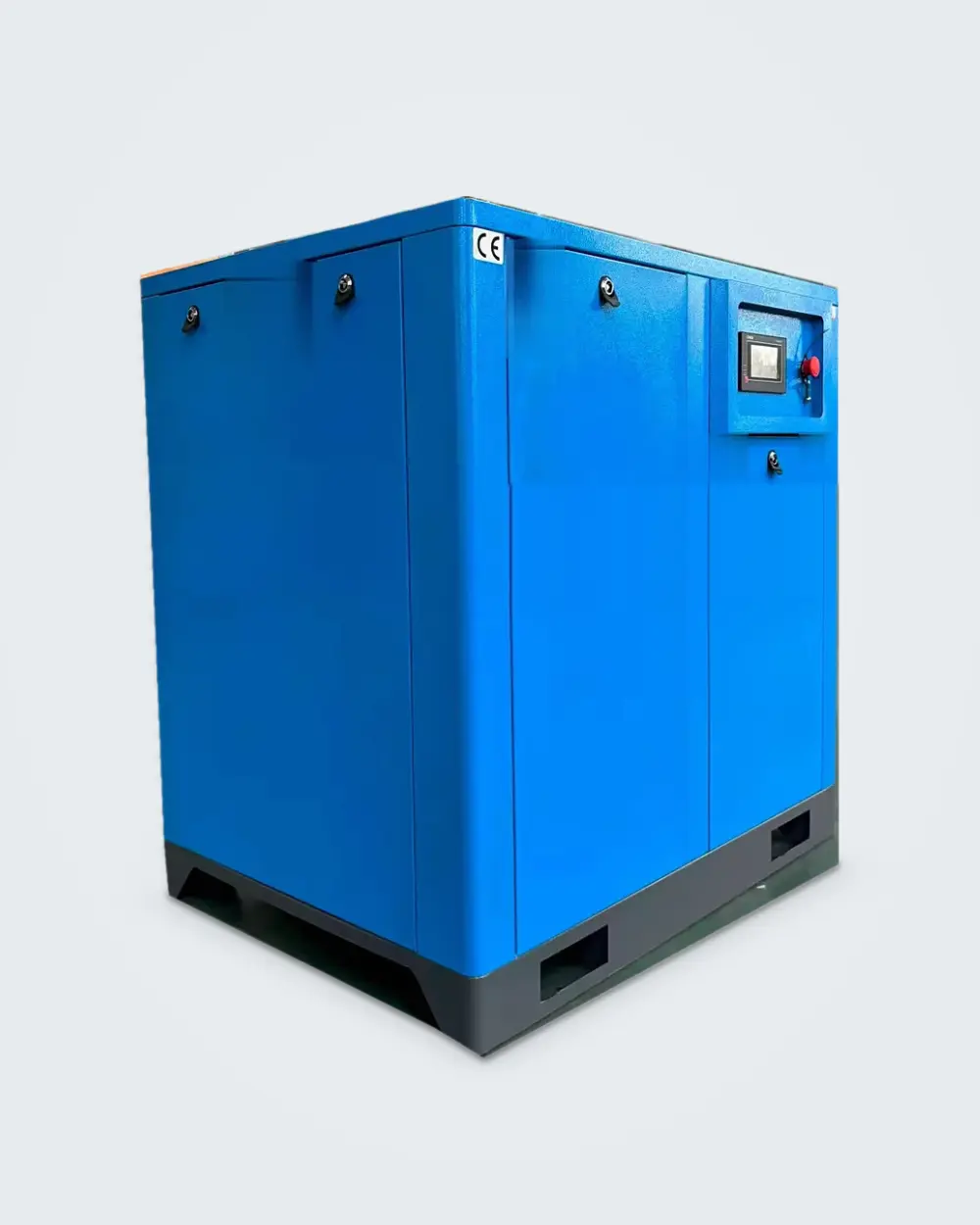 5.5kW
S 55Screw compressor 5.5 kW
The entry-level screw compressor for workshops that run all day long.
 7.5kW
K 75Screw compressor 7.5 kW 4-in-1
Compressor, 420 L air receiver, refrigerated dryer and filtration combined on a single frame.
 15kW
K 150Screw compressor 15 kW 4-in-1
Compressor, air receiver, refrigerated dryer and filtration combined on a single frame, at 15 kW.
 22kW
S 220 PMScrew compressor 22 kW permanent magnet
Permanent magnet motor, 10 bar: the industrial machine of the range.
Other trades
A project, a question?
We answer quickly and quotes are free. Tell us what you run on air and we'll point you to the right model.