Upholstery and trimming
Compressor for upholstery, auto trimming and soft furnishing workshops
Air compressor for upholstery and auto trimming: staple guns, glue spray gun, blow gun. Flow worked out, a quiet workshop, dry air that won't stain fabric.
An upholstery or trimming workshop with 2 to 4 people uses, as a guide, 250 to 550 l/min including margins: a few staple guns, a glue spray gun for the foam and a blow gun. An E series piston compressor is enough for occasional use; an S 55 screw compressor (0.6 m³/min at 8 bar, 65 to 68 dB(A)) is the right fit as soon as you are stapling all day long. For a production workshop making seats or mattresses, the K 75 4-in-1 supplies 1.1 m³/min (about 39 CFM) of dry, filtered air.
The furniture upholsterer, the automotive or marine trimmer and the seat or mattress manufacturer all share the same needs: light tools that use little air but fire thousands of times a day, a workshop that is often in town or on the ground floor of a building, and light-coloured fabrics that the smallest drop of oil or water will spoil. The compressor therefore has to be correctly sized, discreet and followed by a proper drying and filtration chain.
Which air tools does an upholsterer use?
The figures below are orders of magnitude, given as a guide only. The exact consumption is in each tool's manual.
| Tool | Indicative consumption | Working pressure | Use |
|---|---|---|---|
| Upholstery staple gun (fine wire staples) | around 50 to 100 l/min depending on the firing rate | 5 to 7 bar | in bursts |
| Tack nailer | around 50 to 80 l/min | 5 to 7 bar | in bursts |
| Contact adhesive spray gun (foam, wadding) | around 100 to 200 l/min | 2 to 4 bar | in continuous sessions |
| Pneumatic scissors | around 80 to 120 l/min | about 6 bar | in bursts |
| Blow gun (dust, threads, offcuts) | around 150 l/min | 6 bar | in bursts |
The upholstery staple gun is the king of the trade. Its consumption depends on the number of staples fired per minute: an upholsterer covering seat pads on a production line fires far more than a restorer of antique armchairs. The full calculation is in our article which compressor for an upholstery staple gun.
How much air does an upholstery workshop need?
Take an upholstery and trimming workshop with four people: three staple guns, one glue spray gun for bonding foam and one blow gun. The calculation follows the method used by our configurator.
Step 1, the staple guns. Three staple guns at 80 l/min, used in bursts. The air receiver absorbs the peaks, so they are counted at 50%: 3 × 40 = 120 l/min.
Step 2, the glue spray gun. When a block of foam is being glued, the gun blows without stopping: count it in full, so 150 l/min.
Step 3, the blow gun. 150 l/min in bursts, counted at 50%: 75 l/min.
Step 4, the total. 120 + 150 + 75 = 345 l/min.
Step 5, the margins. Add 25% for safety, to cover leaks and tool wear: 345 × 1.25 = 431 l/min. Then 20% for expansion, for one more workstation: 431 × 1.2 = about 520 l/min, or 0.52 m³/min.
The S 55, which delivers 0.6 m³/min at 8 bar, covers this need. If the workshop adds a second gluing station or moves into seat production, the K 75 takes over. Our article how many staple guns on one compressor gives the full table, workstation by workstation.
What pressure for a staple gun and a glue spray gun?
Staple guns and tack nailers generally work between 5 and 7 bar, depending on the staple length and the hardness of the wood in the frame. The glue spray gun, on the other hand, works at a low pressure, often between 2 and 4 bar: too much pressure turns the adhesive into a mist that settles everywhere and is wasted. Set the compressor at around 8 bar and fit a regulator at each workstation, especially at the gluing station. Fine-tuning the gun is covered in our article foam glue spray gun: air flow and pressure.
Which compressor for an upholstery or trimming workshop?
An upholsterer working alone or in pairs, occasional use: the E series
For one or two stapling stations, with breaks between pieces, a piston compressor does the job. The E 40, 4 kW on a 100 L air receiver, suits the smallest workshops. The E 75 delivers 0.9 m³/min on a 180 L air receiver and leaves spare capacity for the glue spray gun. The E series piston compressors are available on quotation. They are louder than a screw compressor: plan for a separate room.
A workshop that staples all day: the S 55
When three or four people are stapling and gluing from morning to night, a piston compressor no longer gets its rest periods. The S 55, a 5.5 kW screw compressor, is built for continuous work, delivers 0.6 m³/min at 8 bar and stays at around 65 to 68 dB(A). Its variable speed matches output to the number of tools firing. It is supplied on its own: add an air receiver, a refrigerated dryer and filters.
A production workshop, seats, mattresses: the K 75 or the K 110
The K 75 combines, on a single frame, a 7.5 kW screw compressor, a 420 L air receiver, a refrigerated dryer and the filtration. It delivers 1.1 m³/min at 8 bar, at 66 ± 2 dB(A). It is the simplest solution for an auto trimming shop or a seat manufacturing workshop with 5 to 8 workstations. Beyond that, or with a foam gluing line for mattress manufacturing, the K 110 goes up to 1.7 m³/min at 8 bar.
How do you get a quiet compressor in a town-centre workshop?
Many upholsterers work in a shop, in a courtyard or on the ground floor of a building, with neighbours upstairs. Compressor noise then becomes as important a criterion as air flow. A screw compressor such as the S 55 or the K 75 runs at around 65 to 68 dB(A), and its variable speed avoids the abrupt starts of a piston compressor. Stand it on anti-vibration mounts, away from the party wall, and switch it off outside opening hours. Our page quiet workshop compressor and the article quiet compressor for an upholstery workshop in town set out the installation rules.
Why must the air be dry so it does not stain fabric?
Air leaves the compressor hot and loaded with moisture. As it cools in the pipes, this water condenses and ends up coming out of the blow gun or the glue spray gun. On velvet, light linen or natural leather, a drop of water leaves a ring. A drop of oily water leaves a grey stain that will not come out.
Our compressors are lubricated: it is the filtration at the outlet that holds back the oil carried along with the air. The basic chain includes a refrigerated dryer, a particulate filter and a coalescing filter. At the point of use, in front of the blow gun and the glue spray gun, add fine filters, with an activated carbon filter if you blow directly onto light-coloured fabrics. If a customer specifies an air quality class, our technicians will define the treatment with you under the ISO 8573-1 standard. All the details are in our article dry, filtered air: no oil stains on the fabric.
Installation and maintenance
- The room. Fibres, stuffing and foam dust quickly clog the intake filter. Place the air intake well away from the cutting area and the upholstery benches. See our article on the compressor room.
- Solvent-based adhesives. Never place the compressor in the area where solvent-based adhesive is sprayed: it would draw in the vapours. Install it in a separate, ventilated room.
- Condensate. An automatic drain on the air receiver means draining is never forgotten. This condensate contains oil: it has to be collected and must not go down the drain.
- Leaks. Quick couplings and hoses trailing on the floor under the trestles soon start to leak. The leak cost calculator puts a figure on them.
- Maintenance. On screw compressors, the first service is at 500 hours, then every 1,500 hours, with service kits available online. 2-year warranty, spare parts available for 15 years.
Joiners who make seat frames have similar needs: see our page compressor for joinery workshops.
To size your installation, enter your staple guns and spray guns in the configurator, or send us the list of your tools with a quote request.
Typical tools in this trade
| Tool | Consumption | Typical number |
|---|---|---|
| Nailer / stapler | ≈ 80 l/min | 3 |
| Contact adhesive spray gun (foam) | ≈ 150 l/min | 1 |
| Pneumatic shears | ≈ 100 l/min | 1 |
| Blow gun | ≈ 150 l/min | 1 |
Indicative average consumption. The configurator calculates your exact demand.
AIRSTAHL Lab
Recommended air quality
Painting and finishing — Dry, filtered air for paint and clearcoat spray guns.
Calculate my demand for this tradeFrequently asked questions — Upholstery and trimming
Which compressor do you need for an upholstery staple gun?
An upholstery staple gun uses, as a guide, around 50 to 100 l/min depending on the firing rate, at 5 to 7 bar. For one or two staple guns used now and then, an E 40 or E 75 piston compressor is enough. If several people are stapling all day long, an S 55 screw compressor (0.6 m³/min at 8 bar) keeps up with the pace.
How many staple guns can you run on one compressor?
With one blow gun, a 25% margin and a 20% reserve, an S 55 supplies about 8 staple guns used in bursts, or 4 firing continuously. A K 75 (1.1 m³/min at 8 bar) supplies about 16 in everyday upholstery work. The details are in our article how many staple guns on one compressor.
What air flow does an upholstery workshop with 3 or 4 people need?
With three staple guns counted at 50%, one adhesive spray gun counted at 100% and one blow gun, the need is about 345 l/min. With 25% for safety and 20% for expansion, you reach about 520 l/min. An S 55 (600 l/min at 8 bar) covers this need; check it with your manuals in the configurator.
What pressure should you set for a foam adhesive spray gun?
As a guide, a contact adhesive spray gun works at 2 to 4 bar at the gun, and a pressurised adhesive pot often at 1 to 2 bar. Set the network at around 8 bar and fit a regulator with a pressure gauge at the gluing station. Always follow the adhesive manufacturer's data sheet.
Piston or screw compressor for an upholsterer?
A piston compressor suits an upholsterer working alone or in pairs who staples for a few hours a day, with breaks. As soon as several people are stapling and gluing all day long, a screw compressor is the better fit: it handles continuous work, and its variable speed follows demand. It is also quieter, at around 65 to 68 dB(A) for the S 55.
How do you get a quiet compressor in a town-centre upholstery workshop?
Choose a variable-speed screw compressor such as the S 55 (65 to 68 dB(A)) or the K 75 (66 ± 2 dB(A)). Stand it on anti-vibration mounts in a separate room, away from party walls, and switch it off at closing time. See our article quiet compressor for an upholstery workshop.
How do you avoid oil and water stains on fabric?
Install a refrigerated dryer, a particulate filter and a coalescing filter at the compressor outlet, then a fine filter, or even an activated carbon filter, in front of the blow gun and the adhesive spray gun. Drain the condensate automatically and do not over-oil the staple guns. The K 75 already includes the dryer and outlet filtration.
Which compressor for a seat or mattress manufacturing workshop?
A production workshop with several gluing stations and around ten staple guns needs around 0.8 to 1.5 m³/min. The K 75 (1.1 m³/min at 8 bar, 420 L air receiver, built-in dryer) covers a need of up to 1.1 m³/min, margins included; beyond that, the K 110 goes up to 1.7 m³/min. Send us the list of your workstations with a quote request.
The recommended models
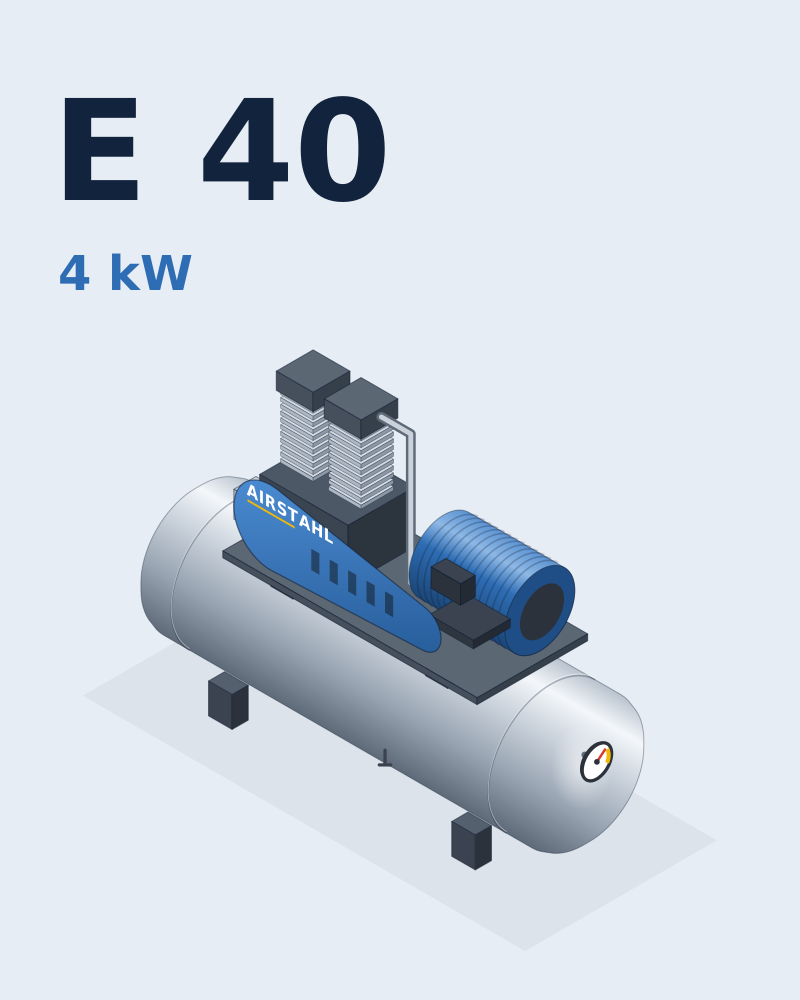 4kW
E 40Piston compressor 4 kW
A piston compressor on its receiver, ready to plug in, for the workshop and the garage.
 7.5kW
E 75Piston compressor 7.5 kW
More power for the garage's air tools.
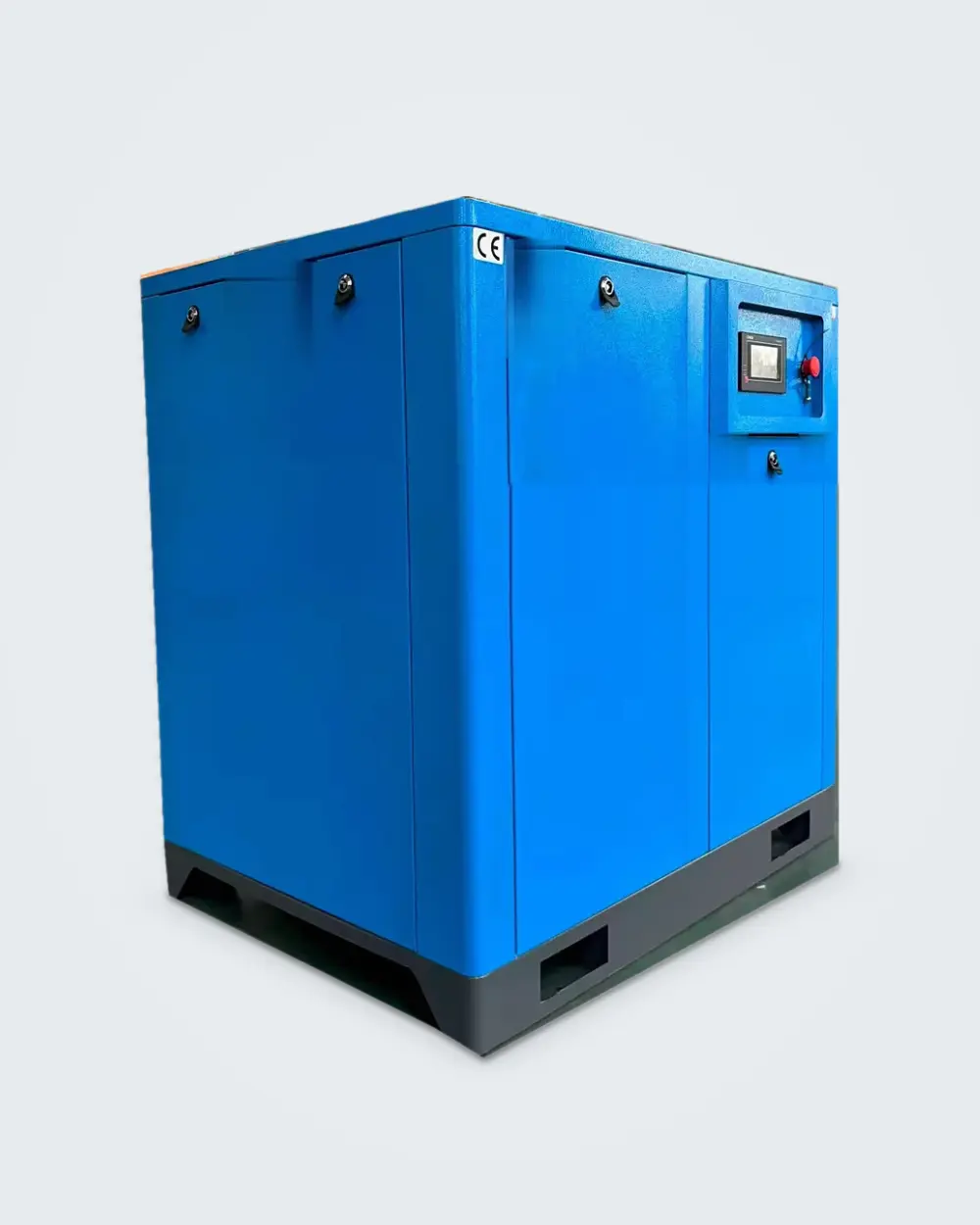 5.5kW
S 55Screw compressor 5.5 kW
The entry-level screw compressor for workshops that run all day long.
 7.5kW
K 75Screw compressor 7.5 kW 4-in-1
Compressor, 420 L air receiver, refrigerated dryer and filtration combined on a single frame.
11kW
K 110Screw compressor 11 kW 4-in-1
Compressor, air receiver, refrigerated dryer and filtration combined on a single frame, at 11 kW.
Other trades
A project, a question?
We answer quickly and quotes are free. Tell us what you run on air and we'll point you to the right model.