Dairy farming and milking robots
Air compressor for dairy farms and milking robots
Air compressor for milking robots and dairy farms. Flow for 1, 2 or 3 robots, dry air against freezing, backup and alarm. Variable speed screw units.
For one or two milking robots, a 7.5 kW 4-in-1 screw compressor such as the K 75 is enough on most dairy farms. It delivers 1.1 m³/min (about 39 CFM) at 8 bar, with a 420 L air receiver, dryer and filtration built in. For three robots, allow for a K 110 delivering 1.7 m³/min instead. Because the robot milks day and night, also plan for a second compressor as a backup and a low-pressure alarm.
On a dairy farm, compressed air is no longer just for pumping up tractor tyres. On a milking robot it drives the arm cylinders, opens and closes the box gates, operates the valves in the milk circuit and rinses the teat cups. In the cow shed it controls the automatic gates, the sort gate that sends a cow to the treatment pen or for insemination, and sometimes the scrapers or the feed barriers. When the air stops, the robot stops, and milking stops with it. The compressor becomes a production machine, just like the bulk milk tank.
How much air does a milking robot use?
Consumption depends on the robot's model and configuration, and it is given in the manual or by the installer. As a guide, a milking robot uses roughly 200 to 400 l/min on average, with peaks when the arm moves and the gates open. The pressure required at the robot inlet is often around 6 to 8 bar. Check the exact figure in the manual, because a robot that is short of pressure goes into fault.
The other consumers count for little, but they add up:
| Equipment | Indicative consumption | Operation |
|---|---|---|
| Milking robot | roughly 200 to 400 l/min | day and night |
| Sort gate, automatic gate | roughly 50 l/min | in bursts |
| Workshop blow gun | roughly 150 l/min | in bursts |
| Scrapers, feed barriers, pneumatic valves | see the manual | in bursts |
These figures are for rough sizing. For the final choice, start from the manuals of your equipment.
Which compressor for 1, 2 or 3 milking robots?
Our configurator uses a simple method. It adds up the equipment, counts continuously running items at 100% and those used in bursts at 50%, then adds a 25% safety margin and 20% for future expansion.
Example of a farm with two robots, a sort gate and a blow gun (guide values):
- Two robots, counted as continuous: 2 × 300 = 600 l/min.
- Sort gate, in bursts: 50 × 50% = 25 l/min.
- Blow gun, in bursts: 150 × 50% = 75 l/min.
- Total: 700 l/min.
- Safety margin of 25%: 700 × 1.25 = 875 l/min.
- Expansion of 20%: 875 × 1.2 = 1,050 l/min.
The K 75 delivers 1,100 l/min at 8 bar, so it covers this demand. Its 420 L receiver is larger than the volume recommended by our configurator, about one litre for every 3 l/min of demand, or 350 L here.
Using the same method:
- One robot: about 400 l/min, or 600 l/min with the margins. The S 55 (5.5 kW, 0.6 m³/min at 8 bar) is enough, provided you add an air receiver and a dryer. The K 75 leaves room for a second robot.
- Two robots: the K 75, as in the example.
- Three robots: about 1,025 l/min, or 1,540 l/min with the margins. The K 110 delivers 1.7 m³/min at 8 bar.
The detailed calculation, robot by robot, is in our article which compressor for 1, 2 or 3 milking robots.
Why a variable speed screw compressor?
A milking robot uses air 24 hours a day, with a flow that varies as the cows come through. A piston compressor is not built to run continuously. Our screw compressors in the S and K series are variable speed: at night, when the cows visit less often, the motor slows down instead of running idle. The pressure stays steady, which the robot likes, and the power consumption follows the real demand. Our compressor electricity cost calculator gives an order of magnitude over a year of continuous running.
All our compressors run on 380 V three-phase, the usual supply on farms equipped with a robot.
What if the compressor breaks down?
No air, no milking. A cow that is not milked on time waits in front of the box, the herd's routine falls apart, and a few hours of downtime are paid for in lost milk and stressed animals. Three precautions are essential:
- A second compressor. Two machines that take turns, or a main compressor and a smaller backup that covers at least the robots' consumption.
- A low-pressure alarm, linked to the farm's alarm system, so you are warned before the robot stops.
- Backup power. If the farm has a generator for the robot and the milk tank, it must also power the compressor. Check its capacity with your electrician.
Our article backup compressor and keeping the robot milking details the possible set-ups, and our general article on the backup compressor explains how to work out the critical flow.
Does a milking robot need dry air?
Yes. The air leaving the compressor is hot and full of water. As it cools in the pipes, that water condenses. In a robot it damages the valves and cylinders. In winter, in an open-sided cow shed, it freezes, and a pipe blocked by ice stops the robot as surely as a compressor failure.
- Network in a frost-free room: the refrigerated dryer built into the K series is enough.
- Pipes that cross the cow shed or run outside: you need a sub-zero dew point, so a desiccant dryer.
- In every case: an automatic condensate drain on the receiver and at the low points.
Our compressors are oil-lubricated. Carried-over oil is captured by the outlet filtration. If the air touches the teat cups or the milk circuit, add fine filters at the point of use and set the ISO 8573-1 air class with our technicians and the robot installer. See our article dry air and freezing in the cow shed.
Where should the compressor go on a dairy farm?
A farm is not a clean workshop: forage dust, ammonia from manure, heat in summer, cold in winter. The compressor sucks all of that in. Install it in a closed room, away from the cow shed, ventilated, frost-free and with a clean air intake. Ammonia attacks copper and electrical contacts, and dust clogs the intake filter and the cooler. Our article on the compressor room on a dairy farm gives the rules step by step.
What about automatic gates and the sort gate?
Cow traffic gates, the sort gate, the collecting yard gates and sometimes the scrapers run on pneumatic cylinders. They use little air, but they are often far from the compressor and out in the cold. A sort gate that sticks lets through a cow that was meant to go to the treatment pen. See our article automatic gates and the sort gate.
Servicing a compressor that runs day and night
First service at 500 hours, then every 1,500 hours. On a milking robot the compressor may run almost all the time, so 1,500 hours is about 9 weeks. Plan the servicing like the robot's own, and do it while the backup compressor keeps the milking going. The service kits group the parts for each model. 2-year warranty, parts available for 15 years.
For the other uses of air on the farm, such as tyre inflation, greasing and the workshop, see our page on the compressor for agriculture.
To choose your model, enter your robots and gates in the configurator, then send us your robot's manual with a quote request.
Typical tools in this trade
| Tool | Consumption | Typical number |
|---|---|---|
| Milking robot (per robot) | ≈ 300 l/min | 2 |
| Sorting gate / automatic gate (livestock) | ≈ 50 l/min | 1 |
| Blow gun | ≈ 150 l/min | 1 |
Indicative average consumption. The configurator calculates your exact demand.
AIRSTAHL Lab
Recommended air quality
Painting and finishing — Dry, filtered air for paint and clearcoat spray guns.
Calculate my demand for this tradeFrequently asked questions — Dairy farming and milking robots
What size compressor does a milking robot need?
As a guide, a milking robot uses roughly 200 to 400 l/min continuously, day and night; the robot's manual gives the exact figure. For one robot, a 5.5 kW screw compressor such as the S 55 (0.6 m³/min at 8 bar) with an air receiver and dryer is usually enough. The K 75 4-in-1 leaves room for a second robot.
Which compressor for two or three milking robots?
For two robots at 300 l/min, with a sort gate and a blow gun, the demand is about 700 l/min, or 1,050 l/min with a 25% safety margin and 20% expansion: the K 75 (1.1 m³/min at 8 bar) covers it. For three robots, allow about 1,540 l/min with the margins: the K 110 delivers 1.7 m³/min. Always check the consumption in your robots' manuals.
What pressure does a milking robot need?
The supply pressure is given in the robot's manual, often around 6 to 8 bar. Add the losses in the dryer, filters and pipework, and set the compressor accordingly, usually at 8 bar. A robot that is short of pressure goes into fault and stops milking.
Does a milking robot need a backup compressor?
Yes, because a robot with no air stops milking, day and night. The safest option is to install two compressors that take turns, each able to cover at least the robots' consumption with a 25% margin: for two robots at 300 l/min, at least 750 l/min. Add a low-pressure alarm linked to the farm's alarm dialler. See our article on the backup compressor for a milking robot.
Why does compressed air freeze in the cow shed in winter?
Compressed air contains water that condenses wherever the pipe cools down. A refrigerated dryer gives a dew point a few degrees above zero, which is enough if the whole network stays frost-free. If a pipe crosses an open-sided cow shed or runs outside, you need a desiccant dryer with a sub-zero dew point, at least on that branch, and drains at the low points.
Where should the compressor go on a dairy farm?
In a closed room, separate from the cow shed, ventilated and frost-free, with a clean air intake away from manure and forage. Ammonia attacks copper and electrical contacts, and dust clogs the filter and the cooler. For a 7.5 kW compressor, allow around 2,300 m³/h of ventilation air to limit the room's temperature rise to 10 °C. See our article on the compressor room on a dairy farm.
Can the robot's compressor also supply the sort gates and the workshop?
Yes for sort gates and automatic gates: they use around 50 l/min in bursts, as a guide, and count for little next to the robots. The workshop is trickier: an impact wrench or a grinder can make the pressure drop during milking. Separate the workshop with a valve and a pressure regulator, or give it its own compressor.
How often should a milking robot's compressor be serviced?
Our screw compressors have their first service at 500 hours, then every 1,500 hours. A robot compressor running almost continuously reaches 1,500 hours in about 9 weeks. In a dusty environment, also check the intake filter more often, and do the servicing while the backup compressor keeps the milking going. The service kits group the parts for each model.
The recommended models
 7.5kW
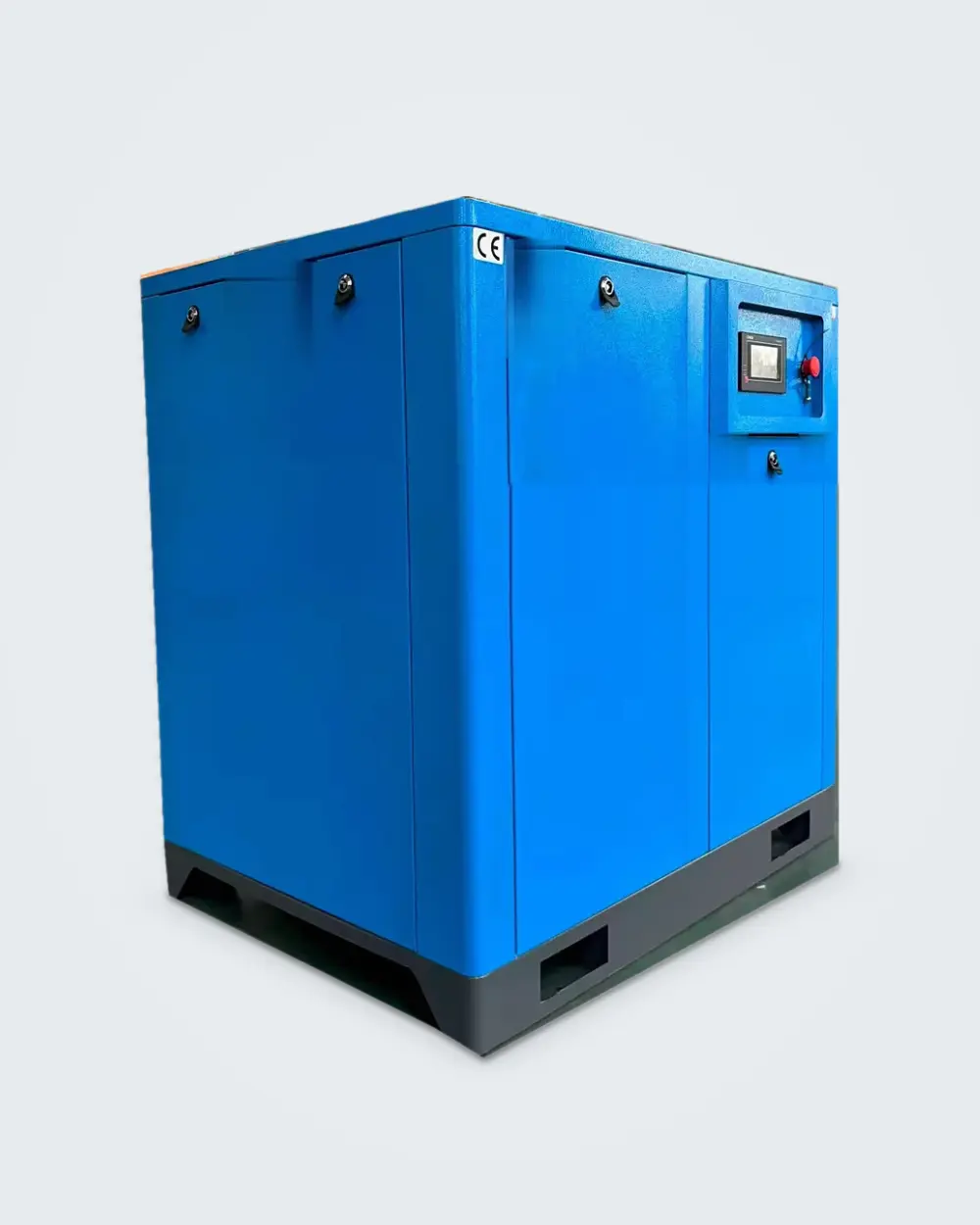
K 75Screw compressor 7.5 kW 4-in-1
Compressor, 420 L air receiver, refrigerated dryer and filtration combined on a single frame.
 5.5kW
S 55Screw compressor 5.5 kW
The entry-level screw compressor for workshops that run all day long.
11kW
K 110Screw compressor 11 kW 4-in-1
Compressor, air receiver, refrigerated dryer and filtration combined on a single frame, at 11 kW.
7.5kW
S 75Screw compressor 7.5 kW
The power to supply several workstations at the same time, without losing pace.
Other trades
A project, a question?
We answer quickly and quotes are free. Tell us what you run on air and we'll point you to the right model.