Textile and industrial laundry
Compressor for the textile industry and laundries
Screw compressor for textile plants and industrial laundries, sewing and embroidery machines, garment presses, folders and tunnel washers. Dry, filtered air.
In textile production and laundries, compressed air works at every stage. In garment making, it drives the thread trimmer, the presser foot lifter and the automatic functions of industrial sewing and embroidery machines. In finishing, it closes the garment presses and inflates the form finishers. In an industrial laundry, it operates the valves and cylinders of the tunnel washer and the extraction press, and it blows the linen into shape in the folding machines. In weaving, it carries the weft across air-jet looms. Wherever it is used, a drop of water or oil in the air can mark a garment or a sheet.
How much air does a textile workshop need?
Add up the consumption of the machines, apply the share that runs at the same time, then add a margin. The figures below are typical orders of magnitude, given for guidance only: the exact consumption is on each manufacturer's data sheet.
- Industrial sewing machine with pneumatic functions: 5 to 30 l/min.
- Industrial embroidery machine: 10 to 50 l/min.
- Pneumatic garment press: 100 to 300 l/min during the cycle.
- Linen folding machine: 100 to 400 l/min, depending on the number of air jets.
- Air-jet loom: several hundred l/min per loom, depending on width and speed.
Example of a garment workshop:
- 25 sewing machines at 20 l/min, with 60% running at the same time: 300 l/min.
- 2 embroidery machines at 30 l/min: 60 l/min.
- 2 garment presses at 200 l/min, which do not close at the same time: 200 l/min.
- 2 blow guns at 150 l/min, one at a time: 150 l/min.
Total: 710 l/min. With a 20% margin for leaks and future machines, you need around 850 l/min, or 0.85 m³/min. These machines mostly work at around 6 bar, so a compressor set to 8 bar is suitable. Our flow and pressure converter switches between l/min and m³/min.
Which compressor for textiles and laundries?
Embroidery shop or small garment workshop: the S 55
A few embroidery machines and around ten sewing machines use little air. The S 55 delivers 0.6 m³/min at 8 bar. It is compact (750 × 550 × 750 mm, 98 kg) with a sound level of 65 to 68 ± 2 dB(A). It comes without an air receiver, so pair it with a receiver, a dryer and a fine filter.
Garment workshop with pressing: the K 75
The example workshop needs 0.85 m³/min. The K 75 delivers 1.1 m³/min at 8 bar. Compressor, 420 L air receiver, refrigerated dryer and filtration share one frame: a single machine to install, with dry air at the outlet. The receiver absorbs the peaks in demand from the presses.
Industrial laundry or multi-shift site: the S 110 or the K 110
A tunnel washer with its press, two ironing lines and several folders quickly go past 1 m³/min. The S 110 and the K 110 both deliver 1.7 m³/min at 8 bar. The K 110 has a 340 L air receiver, dryer and filtration built in. The S 110 suits a laundry that already has its own air network and treatment. Both run at variable speed and follow the demand, which changes a lot through the washing and folding cycles.
An air-jet weaving shed uses far more air. As soon as several looms are running, demand goes beyond the 2.2 m³/min of the S 150. The S series goes up to 132 kW on quotation, and these installations are handled as an industrial project based on your consumption readings.
What air quality does textile work need?
- Water. Compressed air produces water as it cools. Without a dryer, it travels through the network, marks fabric when blowing and rusts the pipes. A refrigerated dryer solves this in most workshops.
- Oil. Our screw compressors are oil-lubricated: at the outlet, the air still contains a few ppm of oil (3 to 5 ppm according to the S series data sheets). On white linen or light fabric, a trace shows. Fine filters mounted in series hold back oil aerosols, and an activated carbon filter holds back vapour for the most sensitive uses.
- Particles. A general-purpose filter protects valves, nozzles and cylinders.
The ISO 8573-1 standard classifies air by these three contaminants. Check what your machine manufacturers require, then work out with our technicians which dryer and filters will meet it. Our ISO 8573-1 air quality guide explains the classes, and our article on fine filters covers filtration.
Installation and maintenance
- Fibres and lint. They are everywhere in a textile workshop or a laundry. The compressor draws them in, and they clog the intake filter and the cooler. Install it in a separate room, check the intake filter more often and blow out the cooler regularly.
- Heat and humidity. A laundry is hot and humid. A compressor breathing that air runs hotter and produces more condensate. Choose a ventilated room away from the dryers and flatwork ironers. Our article on the compressor room sets out the rules.
- Condensate. It contains oil. An automatic condensate drain removes it, and an oil-water separator treats it before discharge.
- Servicing. First service at 500 hours, then every 1,500 hours, with a reminder on the controller. On shift work, these intervals come round quickly. Our service kits group the parts for each model. 2-year warranty, spare parts available for 15 years.
To choose your compressor, use the configurator, size your air receiver with the air receiver calculator, then send us your list of machines in a quote request.
Frequently asked questions — Textile and industrial laundry
Which compressor for a garment workshop?
Add up the consumption of the sewing machines, embroidery machines, presses and blow guns running at the same time, then add a margin of around 20%. An embroidery shop or small garment workshop is often covered by the S 55 (0.6 m³/min at 8 bar), paired with an air receiver and a dryer. A garment workshop with pressing, at around 0.85 m³/min, is well served by a K 75 (1.1 m³/min at 8 bar), which has the receiver, dryer and filtration built in.
Can compressor oil stain linen?
Our screw compressors are oil-lubricated: at the outlet, the air contains a few ppm of oil (3 to 5 ppm according to the S series data sheets). Fine filters in series hold back the aerosols, and an activated carbon filter holds back vapour for the most sensitive uses. The air class is defined with our technicians according to your machines, and the filter elements must be replaced on time.
How much air does an air-jet loom use?
As a guide, several hundred l/min per loom, depending on width and speed; the exact figure is on the manufacturer's data sheet. As soon as several looms are running, demand goes beyond the 2.2 m³/min of the S 150. The S series goes up to 132 kW on quotation, and these installations are handled as an industrial project based on your consumption readings.
Where should the compressor go in a laundry?
In a separate, ventilated room, away from dryers and flatwork ironers. Laundry air is hot, humid and full of lint: the compressor would run hotter, produce more condensate and quickly clog its intake filter and cooler. Also plan for an automatic condensate drain and an oil-water separator.
What maintenance does a compressor need in a textile plant?
First service at 500 hours, then every 1,500 hours, with a reminder on the controller. In textile settings, check the intake filter more often and blow out the cooler, as fibres and lint clog them. AIRSTAHL service kits group the parts for each model, and spare parts stay available for 15 years.
Which compressor for an embroidery shop with 4 to 8 machines?
A shop with 4 to 8 industrial embroidery machines generally needs 250 to 500 l/min, margin included. The S 55 (0.6 m³/min at 8 bar), combined with an air receiver, a dryer and a fine filter, covers this. If the shop adds a transfer press or ironing stations, the K 75 4-in-1 takes over. See our article on the compressor for embroidery machines.
Is a piston compressor suitable for an embroidery shop?
Rarely. A piston compressor is designed for intermittent use, whereas an embroidery shop uses little air, but all day long. A screw compressor is built for that kind of continuous running. It is also quieter: the S 55 is rated at 65 to 68 ± 2 dB(A) and the K 75 at 66 ± 2 dB(A), which helps when the compressor is not far from the work stations.
How can leaks be avoided on a network serving many machines?
Keep the network as short and simple as possible: compressor close to the stations that use the most air, long straight runs of pipe, no dead branches, and as few quick couplings as possible, grouped by station. Choose a closed ring main, take-offs from the top of the main pipe and isolation valves by zone, so part of the shop can be shut off at night. Pressure-test a new network, with the compressor isolated, before connecting the machines.
The recommended models
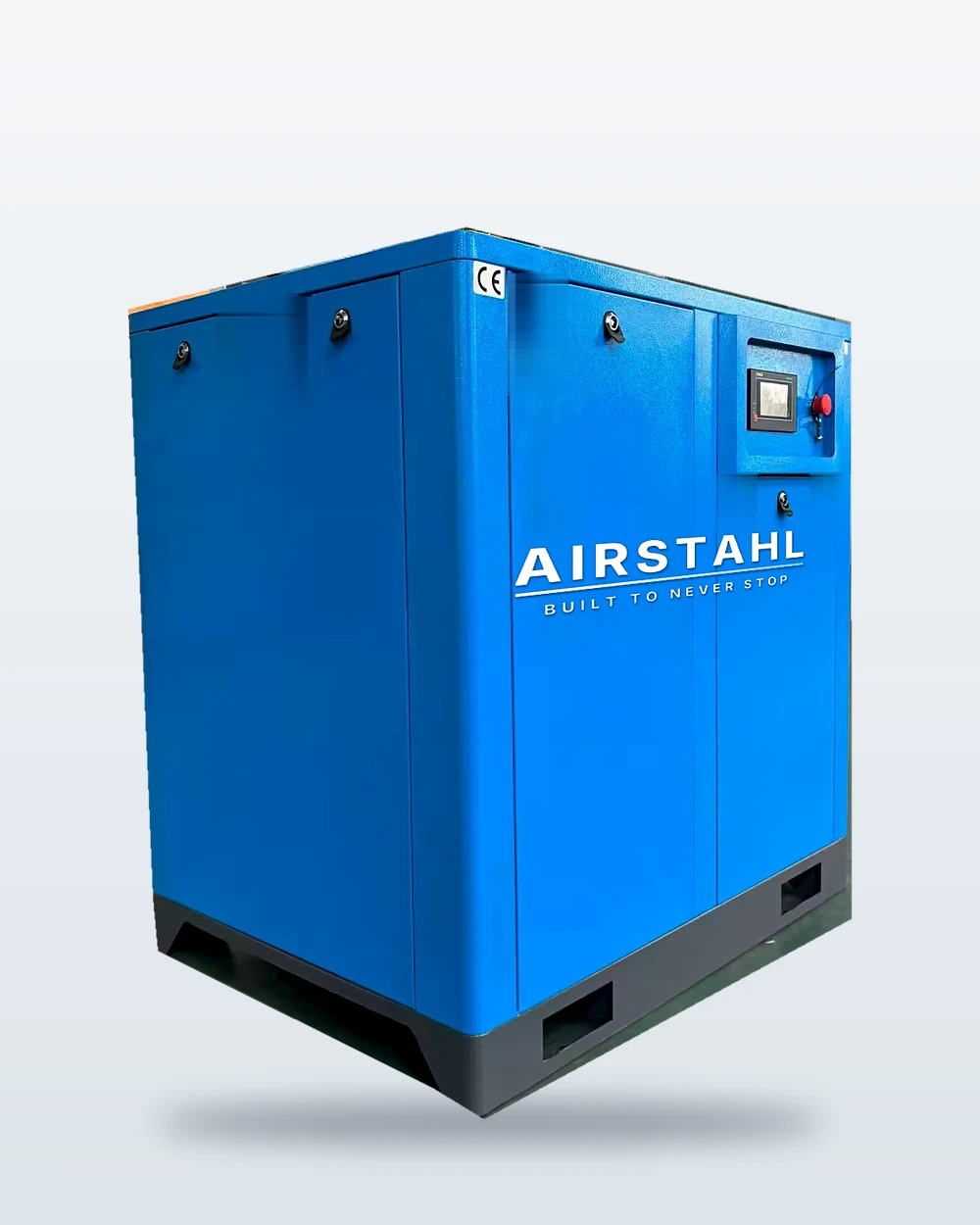 5.5kW
S 55Screw compressor 5.5 kW
The entry-level screw compressor for workshops that run all day long.
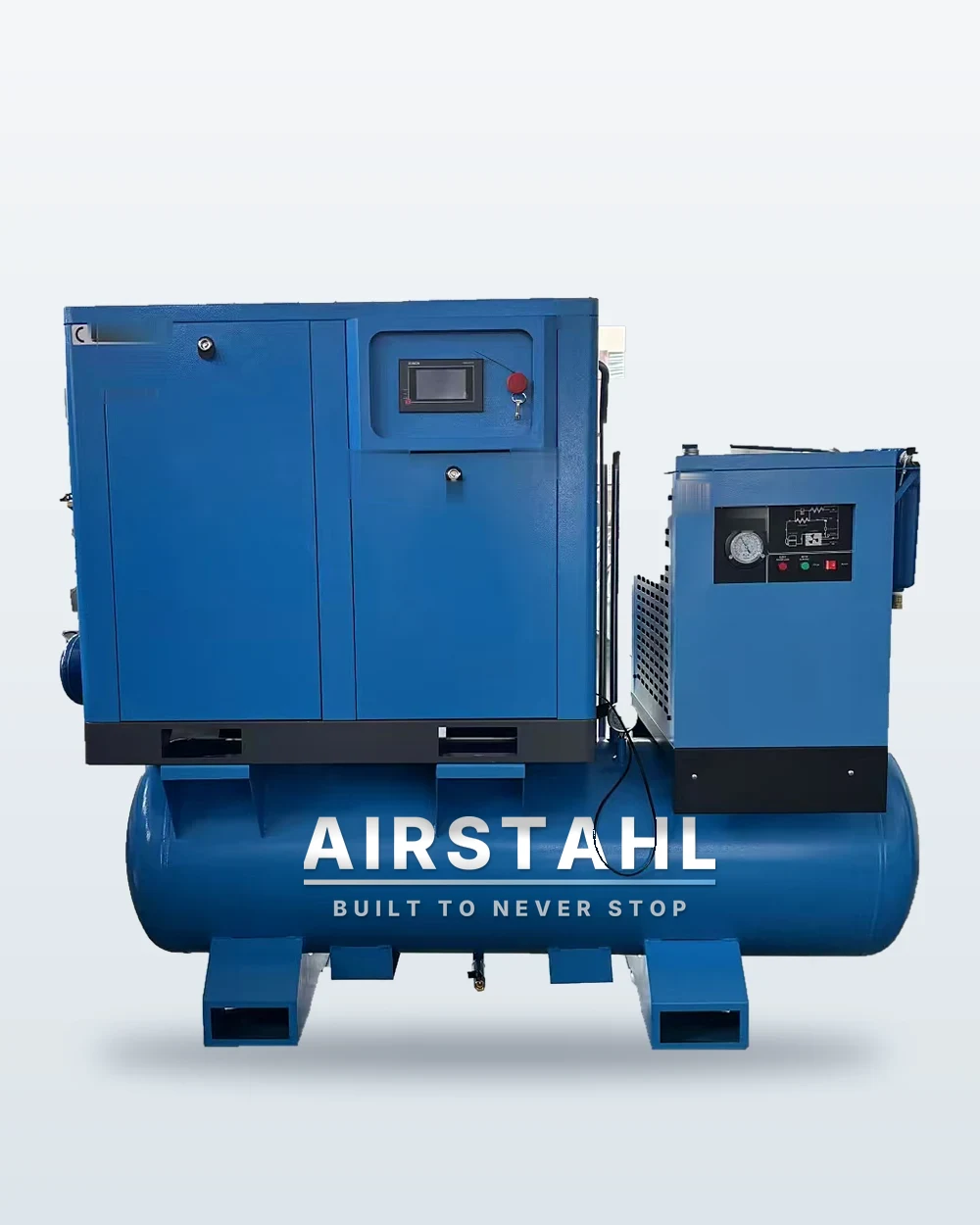 7.5kW
K 75Screw compressor 7.5 kW 4-in-1
Compressor, 420 L air receiver, refrigerated dryer and filtration combined on a single frame.
11kW
S 110Screw compressor 11 kW
The power to supply several workstations at the same time, without losing pace.
11kW
K 110Screw compressor 11 kW 4-in-1
Compressor, air receiver, refrigerated dryer and filtration combined on a single frame, at 11 kW.
Other trades
A project, a question?
We answer quickly and quotes are free. Tell us what you run on air and we'll point you to the right model.